>
Gadiformes (Cods) >
Gadidae (Cods and haddocks)
Etymology: Trisopterus: Greek, tris = thrice + Greek, pteron = wing, fin (Ref. 45335).
Eponymy: Lauritz Martin Esmark (1806–1884) was a Norwegian zoologist. [...] (Ref. 128868), visit book page.
Περιβάλλον: περιβάλλον / κλιματική ζώνη / εύρος βάθους / εύρος διανομής
Οικολογία
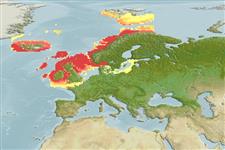
Θαλασσινό(ά) βενθοπελαγικό; ωκεανόδρομο(ς) (Ref. 51243); εύρος βάθους 50 - 300 m (Ref. 54932), usually 100 - 200 m (Ref. 54932). Temperate; 79°N - 48°N, 27°W - 30°E (Ref. 54932)
Northeast Atlantic: southwest Barents Sea, sometimes at Bear Island, south to the English Channel, - and the Bay of Biscaye (Ref. 90172)-, around Iceland and Faeroe Islands.
Μήκος κατά την πρώτη ωρίμανση / Μέγεθος / Βάρος / Ηλικία
Γεννητική Ωρίμανση: Lm 14.0, range 11 - 15 cm
Max length : 35.0 cm TL αρσενικό/απροσδιόριστο; (Ref. 1371); common length : 19.0 cm TL αρσενικό/απροσδιόριστο; (Ref. 4645); μεγ. αναφερόμενη ηλικία: 5 έτη (Ref. 273)
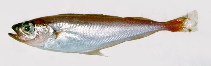
Ραχιαίες άκανθες (συνολικά) : 0; Εδρικές άκανθες: 0. Gray-brown dorsally, silvery on sides, white on belly. A dark blotch is at the upper edge of the pectoral-fin base.
Body shape (shape guide): fusiform / normal; Cross section: circular.
Benthopelagic to pelagic over muddy bottoms. Mostly found between 100 and 200 m. Feeds mostly on planktonic crustaceans (copepods, euphausiids, shrimps, amphipods) but also on small fish and various eggs and larvae (Ref. 1371). Caught mainly for reduction to fishmeal (Ref. 3383), trout pellets, fodder (Ref. 35388).
Oviparous, sexes are separate (Ref. 205). Migrates for spawning between the Shetland Islands and Norway and out of the Skagerrak. Major spawning grounds are Northwestern Scotland, Norway, Faeroe Islands and Iceland.
Cohen, D.M., T. Inada, T. Iwamoto and N. Scialabba, 1990. FAO species catalogue. Vol. 10. Gadiform fishes of the world (Order Gadiformes). An annotated and illustrated catalogue of cods, hakes, grenadiers and other gadiform fishes known to date. FAO Fish. Synop. 125(10). Rome: FAO. 442 p. (Ref. 1371)
Κατάσταση Κόκκινου Καταλόγου IUCN (Ref. 130435: Version 2025-2 (Global))
Απειλή για τον άνθρωπο
Harmless
Ανθρώπινες χρήσεις
αλιεία: πολύ εμπορικό
Εργαλεία
Ειδικές εκθέσεις
Λήψη XML
Διαδικτυακές πηγές
Εκτιμήσεις βάσει μοντέλων
Προτιμώμενη θερμοκρασία (Αναφ.
123201): 5.9 - 10.1, mean 7.8 °C (based on 185 cells).
Δείκτης φυλογενετικής ποικιλότητας (Αναφ.
82804): PD
50 = 0.5625 [Uniqueness, from 0.5 = low to 2.0 = high].
Bayesian length-weight: a=0.00603 (0.00527 - 0.00689), b=3.06 (3.02 - 3.10), in cm total length, based on LWR estimates for this species (Ref.
93245).
Τροφικό Επίπεδο (Αναφ.
69278): 3.2 ±0.0 se; based on diet studies.
Ελαστικότητα (Αναφ.
120179): Μεσαίο(α), ελάχιστος χρόνος για διπλασιασμό πληθυσμού 1,4 - 4,4 έτη (K=0.36; tm=2.3; tmax=5; Fec=27,000).
Prior r = 0.50, 95% CL = 0.33 - 0.75, Based on 3 full stock assessments.
Ευπάθεια στην αλιεία (Ref.
59153): Low to moderate vulnerability (32 of 100).
🛈
Ευπάθεια στο κλίμα (Ref.
125649): Moderate vulnerability (41 of 100).
🛈
Θρεπτικά συστατικά (Ref.
124155): Calcium = 73.1 [20.9, 258.1] mg/100g; Iron = 0.802 [0.170, 3.524] mg/100g; Protein = 17.9 [15.4, 20.0] %; Omega3 = 0.627 [0.304, 1.293] g/100g; Selenium = 17.5 [8.3, 34.9] μg/100g; VitaminA = 25.5 [6.3, 108.2] μg/100g; Zinc = 1.25 [0.31, 3.42] mg/100g (wet weight);