>
Gadiformes (Cods) >
Gadidae (Cods and haddocks)
Etymology: Trisopterus: Greek, tris = thrice + Greek, pteron = wing, fin (Ref. 45335).
Eponymy: Lauritz Martin Esmark (1806–1884) was a Norwegian zoologist. [...] (Ref. 128868), visit book page.
Ambiente: milieu / zona climática / intervalo de profundidade / gama de distribuição
Ecologia
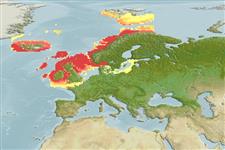
marinhas bentopelágico; oceanódromo (Ref. 51243); intervalo de profundidade 50 - 300 m (Ref. 54932), usually 100 - 200 m (Ref. 54932). Temperate; 79°N - 48°N, 27°W - 30°E (Ref. 54932)
Northeast Atlantic: southwest Barents Sea, sometimes at Bear Island, south to the English Channel, - and the Bay of Biscaye (Ref. 90172)-, around Iceland and Faeroe Islands.
Comprimento na primeira maturidade / Tamanho / Peso / Idade
Maturidade: Lm 14.0, range 11 - 15 cm
Max length : 35.0 cm TL macho/indeterminado; (Ref. 1371); common length : 19.0 cm TL macho/indeterminado; (Ref. 4645); Idade máx. registada: 5 anos (Ref. 273)
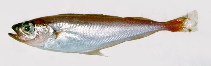
Espinhos dorsais (total) : 0; Espinhos anais: 0. Gray-brown dorsally, silvery on sides, white on belly. A dark blotch is at the upper edge of the pectoral-fin base.
Body shape (shape guide): fusiform / normal; Cross section: circular.
Benthopelagic to pelagic over muddy bottoms. Mostly found between 100 and 200 m. Feeds mostly on planktonic crustaceans (copepods, euphausiids, shrimps, amphipods) but also on small fish and various eggs and larvae (Ref. 1371). Caught mainly for reduction to fishmeal (Ref. 3383), trout pellets, fodder (Ref. 35388).
Oviparous, sexes are separate (Ref. 205). Migrates for spawning between the Shetland Islands and Norway and out of the Skagerrak. Major spawning grounds are Northwestern Scotland, Norway, Faeroe Islands and Iceland.
Cohen, D.M., T. Inada, T. Iwamoto and N. Scialabba, 1990. FAO species catalogue. Vol. 10. Gadiform fishes of the world (Order Gadiformes). An annotated and illustrated catalogue of cods, hakes, grenadiers and other gadiform fishes known to date. FAO Fish. Synop. 125(10). Rome: FAO. 442 p. (Ref. 1371)
Categoria na Lista Vermelha da IUCN (Ref. 130435: Version 2025-2 (Global))
Ameaça para o homem
Harmless
Utilização humana
Pescarias: altamente comercial
Ferramentas
Relatórios especiais
Descarregue XML
Fontes da internet
Estimativas baseadas em modelos
Temperatura preferida (Ref.
123201): 5.9 - 10.1, mean 7.8 °C (based on 185 cells).
Índice de diversidade filogenética (Ref.
82804): PD
50 = 0.5625 [Uniqueness, from 0.5 = low to 2.0 = high].
Bayesian length-weight: a=0.00603 (0.00527 - 0.00689), b=3.06 (3.02 - 3.10), in cm total length, based on LWR estimates for this species (Ref.
93245).
Nível Trófico (Ref.
69278): 3.2 ±0.0 se; based on diet studies.
Resiliência (Ref.
120179): Médio, tempo mínimo de duplicação da população 1,4 - 4,4 anos (K=0.36; tm=2.3; tmax=5; Fec=27,000).
Prior r = 0.50, 95% CL = 0.33 - 0.75, Based on 3 full stock assessments.
Vulnerabilidade da pesca (Ref.
59153): Low to moderate vulnerability (32 of 100).
🛈
Vulnerabilidade climática (Ref.
125649): Moderate vulnerability (41 of 100).
🛈
Nutrientes (Ref.
124155): Calcium = 73.1 [20.9, 258.1] mg/100g; Iron = 0.802 [0.170, 3.524] mg/100g; Protein = 17.9 [15.4, 20.0] %; Omega3 = 0.627 [0.304, 1.293] g/100g; Selenium = 17.5 [8.3, 34.9] μg/100g; VitaminA = 25.5 [6.3, 108.2] μg/100g; Zinc = 1.25 [0.31, 3.42] mg/100g (wet weight);