>
Scombriformes (Mackerels) >
Scombridae (Mackerels, tunas, bonitos) > Scombrinae
Etymology: Scomberomorus: Latin, scomber = mackerel + Greek, moros = silly, stupid (Ref. 45335).
Ambiente: milieu / zona climatica / distribuzione batimetrica / gamma di distribuzione
Ecologia
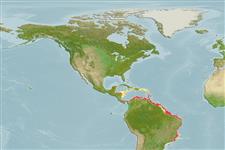
marino associati a barriera corallina; oceanodromo (Ref. 51243). Tropical; 21°N - 36°S, 90°W - 29°W (Ref. 168)
Western Atlantic: along the Caribbean and Atlantic coasts of Central and South America from Belize to Rio Grande do Sul, Brazil. Literature records for Scomberomorus maculatus from the Caribbean and the Atlantic coasts of Central and South America apply to Scomberomorus brasiliensis, which has erroneously been considered a synonym of Scomberomorus maculatus by many authors.
Lunghezza alla prima maturità / Dimensione / Peso / Età
Maturità: Lm 37.0 range ? - ? cm
Max length : 125 cm FL maschio/sesso non determinato; (Ref. 168); common length : 65.0 cm TL maschio/sesso non determinato; (Ref. 9987); peso massimo pubblicato: 6.7 kg (Ref. 40637)
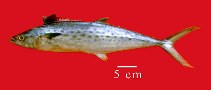
Spine dorsali (totale) : 17 - 19; Raggi dorsali molli (totale) : 15 - 19; Spine anali: 2; Raggi anali molli: 16 - 20; Vertebre: 47 - 49. Snout much shorter than rest of the head. Interpelvic process short and bifid. Lateral line gradually curving down toward caudal peduncle. Body entirely covered with small scales, no anterior corselet developed. Pelvic fins relatively short. Intestine with 2 folds and 3 limbs. Swim bladder absent. Sides silvery with several rows of round yellowish bronze spots. First dorsal fin black.
Body shape (shape guide): fusiform / normal; Cross section: oval.
Does not migrate extensively, although some seasonal movement appears to occur off Trinidad. Feeds largely on fishes, with smaller quantities of penaeid shrimps and loliginid cephalopods. Most of the catch is consumed fresh, but in Brazil some is salted and some has been canned. Also utilized smoked and frozen; used for ceviche (Ref. 9987).
Collette, B.B. and C.E. Nauen, 1983. FAO Species Catalogue. Vol. 2. Scombrids of the world. An annotated and illustrated catalogue of tunas, mackerels, bonitos and related species known to date. Rome: FAO. FAO Fish. Synop. 125(2):137 p. (Ref. 168)
Stato della Lista Rossa IUCN (Ref. 130435: Version 2025-2 (Global))
Minaccia per l'uomo
Harmless
Usi umani
Pesca: commerciale; Pesce da pesca sportiva: si
Strumenti
Rapporti speciali
Scarica XML
Fonti Internet
Stime basate su modelli
Temperatura preferita (Fonte Biblio.
123201): 24.9 - 28, mean 27.5 °C (based on 176 cells).
Indice di diversità filogenetica (Fonte Biblio.
82804): PD
50 = 0.5000 [Uniqueness, from 0.5 = low to 2.0 = high].
Bayesian length-weight: a=0.00776 (0.00479 - 0.01258), b=2.97 (2.84 - 3.10), in cm total length, based on LWR estimates for this species & Genus-body shape (Ref.
93245).
Livello trofico (Fonte Biblio.
69278): 3.3 ±0.4 se; based on diet studies.
Resilienza (Fonte Biblio.
120179): Medio, tempo minimo di raddoppiamento della popolazione 1.4 - 4.4 anni (K=0.18; tm=3-4).
Prior r = 0.56, 95% CL = 0.37 - 0.84, Based on 2 data-limited stock assessments.
Vulnerabilità della pesca (Ref.
59153): High to very high vulnerability (67 of 100).
🛈
Vulnerabilità climatica (Ref.
125649): High to very high vulnerability (75 of 100).
🛈
Nutrienti (Ref.
124155): Calcium = 8.97 [3.62, 31.76] mg/100g; Iron = 0.344 [0.142, 0.904] mg/100g; Protein = 20.4 [18.8, 22.0] %; Omega3 = 0.117 [0.072, 0.195] g/100g; Selenium = 54.5 [16.0, 179.7] μg/100g; VitaminA = 77 [14, 433] μg/100g; Zinc = 0.793 [0.457, 1.403] mg/100g (wet weight); based on
nutrient studies.