>
Scombriformes (Mackerels) >
Scombridae (Mackerels, tunas, bonitos) > Scombrinae
Etymology: Scomberomorus: Latin, scomber = mackerel + Greek, moros = silly, stupid (Ref. 45335).
Miljö: miljö / Klimatzon / djupintervall / distributionsområde
Ekologi
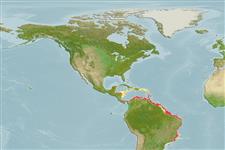
marina revassocierade; havsvandrande (Ref. 51243). Tropical; 21°N - 36°S, 90°W - 29°W (Ref. 168)
Western Atlantic: along the Caribbean and Atlantic coasts of Central and South America from Belize to Rio Grande do Sul, Brazil. Literature records for Scomberomorus maculatus from the Caribbean and the Atlantic coasts of Central and South America apply to Scomberomorus brasiliensis, which has erroneously been considered a synonym of Scomberomorus maculatus by many authors.
Längd vid första mognad / Storlek / Vikt / Ålder
Könsmognad: Lm 37.0 range ? - ? cm
Max length : 125 cm FL hane/ej könsbestämd; (Ref. 168); common length : 65.0 cm TL hane/ej könsbestämd; (Ref. 9987); publicerad maxvikt: 6.7 kg (Ref. 40637)
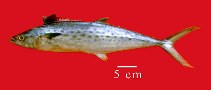
Taggstrålar i ryggfenan (totalt) : 17 - 19; Mjukstrålar i ryggfenan (totalt) : 15 - 19; Taggstrålar i analfenan: 2; Mjukstrålar i analfenan: 16 - 20; Ryggkotor: 47 - 49. Snout much shorter than rest of the head. Interpelvic process short and bifid. Lateral line gradually curving down toward caudal peduncle. Body entirely covered with small scales, no anterior corselet developed. Pelvic fins relatively short. Intestine with 2 folds and 3 limbs. Swim bladder absent. Sides silvery with several rows of round yellowish bronze spots. First dorsal fin black.
Body shape (shape guide): fusiform / normal; Cross section: oval.
Does not migrate extensively, although some seasonal movement appears to occur off Trinidad. Feeds largely on fishes, with smaller quantities of penaeid shrimps and loliginid cephalopods. Most of the catch is consumed fresh, but in Brazil some is salted and some has been canned. Also utilized smoked and frozen; used for ceviche (Ref. 9987).
Collette, B.B. and C.E. Nauen, 1983. FAO Species Catalogue. Vol. 2. Scombrids of the world. An annotated and illustrated catalogue of tunas, mackerels, bonitos and related species known to date. Rome: FAO. FAO Fish. Synop. 125(2):137 p. (Ref. 168)
Status på IUCN:s rödlista (Ref. 130435: Version 2025-2 (Global))
Hot mot människor
Harmless
Mänskliga användningsområden
Fiskeri: kommersiell; sportfisk: ja
Verktyg
Särskilda rapporter
Ladda ner XML
Internet-källor
Uppskattningar baserade på modeller
Önskad temperatur (Ref.
123201): 24.9 - 28, mean 27.5 °C (based on 176 cells).
Index för fylogenetisk mångfald (Ref.
82804): PD
50 = 0.5000 [Uniqueness, from 0.5 = low to 2.0 = high].
Bayesian length-weight: a=0.00776 (0.00479 - 0.01258), b=2.97 (2.84 - 3.10), in cm total length, based on LWR estimates for this species & Genus-body shape (Ref.
93245).
Trofisk nivå (Ref.
69278): 3.3 ±0.4 se; based on diet studies.
Resiliens (Ref.
120179): Mellan, lägsta populationsfördubblingstid 1,4-4,4 år (K=0.18; tm=3-4).
Prior r = 0.56, 95% CL = 0.37 - 0.84, Based on 2 data-limited stock assessments.
Sårbarhet i fisket (Ref.
59153): High to very high vulnerability (67 of 100).
🛈
Sårbarhet för klimatet (Ref.
125649): High to very high vulnerability (75 of 100).
🛈
Näringsämnen (Ref.
124155): Calcium = 8.97 [3.62, 31.76] mg/100g; Iron = 0.344 [0.142, 0.904] mg/100g; Protein = 20.4 [18.8, 22.0] %; Omega3 = 0.117 [0.072, 0.195] g/100g; Selenium = 54.5 [16.0, 179.7] μg/100g; VitaminA = 77 [14, 433] μg/100g; Zinc = 0.793 [0.457, 1.403] mg/100g (wet weight); based on
nutrient studies.