Umwelt: Milieu / Klimazone / Tiefenbereich / Verbreitungsgebiet
Ökologie
seewasser; süßwasser; brackwasser demersal; amphidrom (Ref. 138269). Temperate; 6°C - 20°C (Ref. 2060); 37°S - 44°S
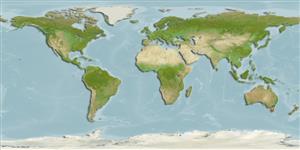
Oceania: widely separated populations in southeastern and southwestern Australia.
Größe / Gewicht / Alter
Geschlechtsreife: Lm ? range ? - ? cm
Max length : 20.0 cm SL Männchen/unbestimmt; (Ref. 44894); common length : 10.0 cm SL Männchen/unbestimmt; (Ref. )
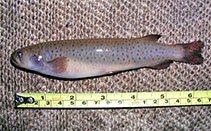
Facultative air-breathing in the genus (Ref. 126274); Adults occur in still or slow-flowing waters at low elevations close to the sea; most abundant along shore margins in rocky areas. They are found around plants, rocks or logs on the margins of still or flowing rivers, streams and lakes (Ref. 44894). Marine juvenile stage is present which is indicative of a diadromous life cycle. Spawning takes place from autumn to winter, among aquatic vegetation. Newly hatched larvae drift downcurrent and out to sea where they spend their first few months, eventually returning to fresh water during spring among annual whitebait migrations. In lacustrine and other landlocked populations, adults move upstream into feeder streams to spawn. The larvae are then swept downstream into lakes (Ref. 44894). Feeds mainly on aquatic and terrestrial insects.
Paxton, J.R., D.F. Hoese, G.R. Allen and J.E. Hanley, 1989. Pisces. Petromyzontidae to Carangidae. Zoological Catalogue of Australia, Vol. 7. Australian Government Publishing Service, Canberra, 665 p. (Ref. 7300)
IUCN Rote Liste Status (Ref. 130435: Version 2025-2 (Global))
Bedrohung für Menschen
Harmless
Nutzung durch Menschen
Fischereien: nicht kommerziell
Tools
Zusatzinformationen
Download XML
Internet Quellen
Schätzungen auf der Grundlage von Modellen
Bevorzugte Temperatur (Ref.
123201): 13.2 - 17.1, mean 15.4 °C (based on 135 cells).
Phylogenetischer Diversitätsindex (Ref.
82804): PD
50 = 0.5000 [Uniqueness, from 0.5 = low to 2.0 = high].
Bayesian length-weight: a=0.00490 (0.00206 - 0.01165), b=3.12 (2.91 - 3.33), in cm total length, based on LWR estimates for this (Sub)family-body shape (Ref.
93245).
Trophische Ebene (Ref.
69278): 2.9 ±0.45 se; based on food items.
Widerstandsfähigkeit (Ref.
120179): mittel, Verdopplung der Population dauert 1,4 - 4,4 Jahre. (Fec=1,175).
Anfälligkeit der Fischerei (Ref.
59153): Low vulnerability (14 of 100).
🛈