分类 / 名称
俗名 | 同种异名 | Catalog of Fishes(属, 种) | ITIS | CoL | WoRMS | Cloffa
环境:氛围 / 气候带 / 深度上下限 / 分布范围
生态学
海洋; 淡水; 半咸淡水 居于水底的; 非产卵性溯降河的 (Ref. 138269). 溫帶; 6°C - 20°C (Ref. 2060); 37°S - 44°S
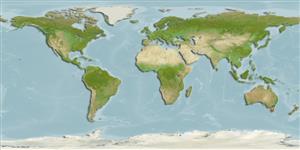
Oceania: widely separated populations in southeastern and southwestern Australia.
大洋洲: 在東南方而西南方的澳洲分得很開族群。
大小 / 重量 / 年龄
成熟度: Lm ? range ? - ? cm
Max length : 20.0 cm SL 雄鱼/尚未辨别雌雄; (Ref. 44894); common length : 10.0 cm SL 雄鱼/尚未辨别雌雄; (Ref. )
Facultative air-breathing in the genus (Ref. 126274); Adults occur in still or slow-flowing waters at low elevations close to the sea; most abundant along shore margins in rocky areas. They are found around plants, rocks or logs on the margins of still or flowing rivers, streams and lakes (Ref. 44894). Marine juvenile stage is present which is indicative of a diadromous life cycle. Spawning takes place from autumn to winter, among aquatic vegetation. Newly hatched larvae drift downcurrent and out to sea where they spend their first few months, eventually returning to fresh water during spring among annual whitebait migrations. In lacustrine and other landlocked populations, adults move upstream into feeder streams to spawn. The larvae are then swept downstream into lakes (Ref. 44894). Feeds mainly on aquatic and terrestrial insects.
出现于在低海拔的静止或流动很慢水域接近海洋; 最丰富的在岩石区中沿着海岸边缘。 在静止或流动河,溪流与湖的边缘上发现于植物 , 岩石或木头周围了。 (参考文献 44894) 此鱼种有一个海洋的幼龄期, 指示的河海洄游性生命周期。 产卵从秋天到冬天发生, 在水生植物之中。 最近孵化了仔鱼漂流物 downcurrent 与向外到海洋在那里它们度过他们的最初几个月, 最后在一年一次的白鱼科的鱼回游之中回到淡水春天时。 在湖泊与其他的陆封族群,成鱼移动向上游进入捕食者溪流到之内产卵。 仔鱼然后进入湖之內被沖到下游。 (參考文獻 44894) 主要吃水生與陸棲的昆蟲。
生命周期和交配行为
成熟度 | 繁殖 | 产卵场 | 卵 | 孕卵数 | 仔鱼
大洋洲: 在東南方而西南方的澳洲分得很開族群。
Paxton, J.R., D.F. Hoese, G.R. Allen and J.E. Hanley, 1989. Pisces. Petromyzontidae to Carangidae. Zoological Catalogue of Australia, Vol. 7. Australian Government Publishing Service, Canberra, 665 p. (Ref. 7300)
世界自然保护联盟红皮书 (Ref. 130435: Version 2025-2 (Global))
人类利用
渔业: 没有兴趣
工具
特别资料
下载 XML
网络资源
基于模型的估算
首选温度 (参考文献
123201): 13.2 - 17.1, mean 15.4 °C (based on 135 cells).
系统发育多样性指数 (参考文献
82804): PD
50 = 0.5000 [Uniqueness, from 0.5 = low to 2.0 = high].
Bayesian length-weight: a=0.00490 (0.00206 - 0.01165), b=3.12 (2.91 - 3.33), in cm total length, based on LWR estimates for this (Sub)family-body shape (Ref.
93245).
营养阶层 (参考文献
69278): 2.9 ±0.45 se; based on food items.
回复力 (参考文献
120179): 中等的, 族群倍增时间最少 1.4 - 4.4年 (Fec=1,175).
渔业脆弱性 (Ref.
59153): Low vulnerability (14 of 100).
🛈