>
Scombriformes (Mackerels) >
Scombridae (Mackerels, tunas, bonitos) > Scombrinae
Etymology: Scomberomorus: Latin, scomber = mackerel + Greek, moros = silly, stupid (Ref. 45335).
More on author: Macleay.
Lingkungan: lingkungan / zona iklim / kisaran kedalaman / jangkauan distribusi
Ekologi
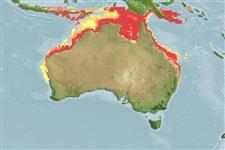
laut; payau pelagic-neritic; oceanodromus (Ref. 51243); kisaran kedalaman ? - 100 m (Ref. 6390). Tropical; 7°S - 30°S, 112°E - 157°E (Ref. 168)
Western Pacific: southern Papua New Guinea and northern Australia, from Shark Bay, Western Australia to northern New South Wales. Reports of this species from Thailand and Malaysia are based on misidentifications.
Panjang pada saat jatuh tempo pertama / Ukuran / Berat / umur
Kematangan: Lm ?, range 75 - ? cm
Max length : 120 cm FL jantan/; (Ref. 168); Berat maksimum terpublikasi: 10.0 kg (Ref. 168)
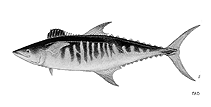
Duri punggung (Keseluruhan (total)) : 13 - 15; duri punggung lunak (Keseluruhan (total)) : 19 - 22; Duri dubur: 0; Sirip dubur lunak: 19 - 22; vertebrata, bertulang belakang: 44 - 46. Interpelvic process small and bifid. Lateral line gradually curving down toward caudal peduncle. Intestine with 2 folds and 3 limbs. Swim bladder absent. Body covered with small scales. Juveniles (less than 10 cm) marked with 12-20 vertical bands which becomes less distinct or break into spots in larger fish.
Body shape (shape guide): fusiform / normal; Cross section: oval.
Found more commonly around coastal headlands and rocky reefs but are also caught offshore (Ref. 6390). Juveniles (4.5 to 10 cm length) are commonly encountered during November along the beaches of Townsville, Queensland and grow to twice this size by January. They are pelagic predators, feeding exclusively on baitfish (sardines and herrings (Ref. 30572). Caught also with set lines aside from trolling with small lures or cut bait. Marketed fresh and frozen; eaten fried, broiled and baked (Ref. 9988).
Collette, B.B. and C.E. Nauen, 1983. FAO Species Catalogue. Vol. 2. Scombrids of the world. An annotated and illustrated catalogue of tunas, mackerels, bonitos and related species known to date. Rome: FAO. FAO Fish. Synop. 125(2):137 p. (Ref. 168)
Status IUCN Red List (Ref. 130435: Version 2025-2 (Global))
ancaman kepada manusia
Reports of ciguatera poisoning (Ref. 6390)
penggunaan manusia
Perikanan: komersial; Ikan buruan: ya; umpan: occasionally
Alat, peralatan
laporan khas
muat turun XML
Sumber internet
Estimasi berdasarkan model
Suhu yang disukai (Acuan
123201): 25.9 - 28.7, mean 27.7 °C (based on 506 cells).
Indeks keanekaragaman filogenetik (Acuan
82804): PD
50 = 0.5000 [Uniqueness, from 0.5 = low to 2.0 = high].
Bayesian length-weight: a=0.00832 (0.00379 - 0.01824), b=3.03 (2.86 - 3.20), in cm total length, based on LWR estimates for this Genus-body shape (Ref.
93245).
Tingkat Trofik (Acuan
69278): 4.5 ±0.80 se; based on food items.
Daya lenting (Acuan
120179): sedang, Waktu penggandaan populasi minimum 1.4 - 4.4 tahun (K=0.40; tm=1-2; tmax=12).
Kerentanan Penangkapan Ikan (Ref.
59153): Moderate to high vulnerability (49 of 100).
🛈
Nutrisi (Ref.
124155): Calcium = 31.7 [14.5, 120.3] mg/100g; Iron = 0.836 [0.391, 2.033] mg/100g; Protein = 21 [20, 22] %; Omega3 = 0.287 [0.173, 0.471] g/100g; Selenium = 64.2 [23.0, 279.1] μg/100g; VitaminA = 15.9 [3.3, 73.6] μg/100g; Zinc = 0.701 [0.470, 1.102] mg/100g (wet weight);