>
Scombriformes (Mackerels) >
Scombridae (Mackerels, tunas, bonitos) > Scombrinae
Etymology: Scomberomorus: Latin, scomber = mackerel + Greek, moros = silly, stupid (Ref. 45335).
More on author: Macleay.
पर्यावरण: पर्यावरण / जलवायु क्षेत्र / गहराई सीमा / वितरण सीमा
पारिस्थितिकी
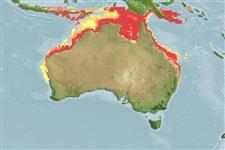
समुद्री; खारा pelagic-neritic; औशिनोड़िरोमस (Ref. 51243); गहराई सीमा ? - 100 m (Ref. 6390). Tropical; 7°S - 30°S, 112°E - 157°E (Ref. 168)
Western Pacific: southern Papua New Guinea and northern Australia, from Shark Bay, Western Australia to northern New South Wales. Reports of this species from Thailand and Malaysia are based on misidentifications.
प्रथम परिपक्वता पर लंबाई / आकार / वज़न / आयु
परिपक्व अवधि: Lm ?, range 75 - ? cm
Max length : 120 cm FL पुल्लिंग / अलिंग; (Ref. 168); अधिकतम प्रकाशित वज़न: 10.0 kg (Ref. 168)
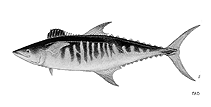
पृष्ठीय रीढ़ (सम्पूर्ण) : 13 - 15; पृष्ठीय सौफट रेज़ (सम्पूर्ण) : 19 - 22; गुदा कांटा: 0; ऐनल सौफट रेज़: 19 - 22; जानवरों की रीड़ का जोड़: 44 - 46. Interpelvic process small and bifid. Lateral line gradually curving down toward caudal peduncle. Intestine with 2 folds and 3 limbs. Swim bladder absent. Body covered with small scales. Juveniles (less than 10 cm) marked with 12-20 vertical bands which becomes less distinct or break into spots in larger fish.
Body shape (shape guide): fusiform / normal; Cross section: oval.
Found more commonly around coastal headlands and rocky reefs but are also caught offshore (Ref. 6390). Juveniles (4.5 to 10 cm length) are commonly encountered during November along the beaches of Townsville, Queensland and grow to twice this size by January. They are pelagic predators, feeding exclusively on baitfish (sardines and herrings (Ref. 30572). Caught also with set lines aside from trolling with small lures or cut bait. Marketed fresh and frozen; eaten fried, broiled and baked (Ref. 9988).
Collette, B.B. and C.E. Nauen, 1983. FAO Species Catalogue. Vol. 2. Scombrids of the world. An annotated and illustrated catalogue of tunas, mackerels, bonitos and related species known to date. Rome: FAO. FAO Fish. Synop. 125(2):137 p. (Ref. 168)
आईयूसीएन रेड लिस्ट स्थिति (Ref. 130435: Version 2025-2 (Global))
मनुष्यों के लिए ख़तरा
Reports of ciguatera poisoning (Ref. 6390)
मानव उपयोग
मात्स्यिकी: व्यापारिक; आखेट मत्स्य: हां; ठहराव / प्रलोभन: occasionally
साधन
विशेष रिपोर्ट
XML डाउनलोड करें
इंटरनेट स्रोत
मॉडल पर आधारित अनुमान
पसंदीदा तापमान (संदर्भ
123201): 25.9 - 28.7, mean 27.7 °C (based on 506 cells).
जातिवृति विविधता सूचकांक (संदर्भ
82804): PD
50 = 0.5000 [Uniqueness, from 0.5 = low to 2.0 = high].
Bayesian length-weight: a=0.00832 (0.00379 - 0.01824), b=3.03 (2.86 - 3.20), in cm total length, based on LWR estimates for this Genus-body shape (Ref.
93245).
ट्रॉफिक स्तर (संदर्भ
69278): 4.5 ±0.80 se; based on food items.
लौटाव (संदर्भ
120179): माध्यम, न्यूनतम जनसंख्या दुगनी होने का समय 1.4 - 4.4 वर्ष। (K=0.40; tm=1-2; tmax=12).
मछली पकड़ने की भेद्यता (Ref.
59153): Moderate to high vulnerability (49 of 100).
🛈
पोषक तत्व (Ref.
124155): Calcium = 31.7 [14.5, 120.3] mg/100g; Iron = 0.836 [0.391, 2.033] mg/100g; Protein = 21 [20, 22] %; Omega3 = 0.287 [0.173, 0.471] g/100g; Selenium = 64.2 [23.0, 279.1] μg/100g; VitaminA = 15.9 [3.3, 73.6] μg/100g; Zinc = 0.701 [0.470, 1.102] mg/100g (wet weight);