>
Eupercaria/misc (Various families in series Eupercaria) >
Lutjanidae (Snappers) > Lutjaninae
Etymology: Lutjanus: Malay, ikan lutjan, name of a fish.
More on author: Forsskål.
Environnement : milieu / zone climatique / profondeur / gamme de distribution
Écologie
marin; eau douce; saumâtre récifal; océanodrome (Ref. 51243); profondeur 1 - 120 m (Ref. 9710). Subtropical; 16°C - 30°C (Ref. 2060); 39°N - 35°S, 26°E - 134°W (Ref. 54571)
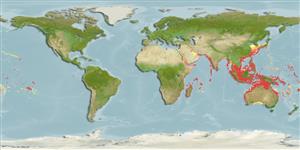
Indo-West Pacific: East Africa to Samoa and the Line Islands, north to the Ryukyu Islands, south to Australia. Has dispersed into the eastern Mediterranean (off Lebanon) via the Suez Canal but not well established there.
Longueur à la première maturité / Taille / Poids / Âge
Maturité: Lm 57.0 range ? - ? cm
Max length : 150 cm TL mâle / non sexé; (Ref. 3678); common length : 80.0 cm TL mâle / non sexé; (Ref. 55); poids max. publié: 12.0 kg (Ref. 132370); âge max. reporté: 31 années (Ref. 82366)
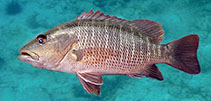
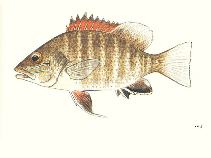
Épines dorsales (Total) : 10; Rayons mous dorsaux (Total) : 13 - 14; Épines anales: 3; Rayons mous anaux: 8. This species is distinguished by the following characters: body moderately deep, greatest depth 2.3 - 2.7 in SL; preopercular notch poorly developed; vomerine tooth patch crescentic; gill rakers of first gill arch 6-8 + 9-12 = 16-20 (including rudiments); scale rows on back more or less parallel to lateral line, or parallel below spinous part of dorsal fin and sometimes rising obliquely posteriorly, or rarely with entirely oblique rows. Colour of the body generally greenish brown on back, grading to reddish; belly silvery or whitish (deep water specimens usually overall reddish); juveniles with a series of about 8 white and streaks 2 blue across cheeks (Ref. 9821, 90102).
Body shape (shape guide): fusiform / normal; Cross section: oval.
A euryhaline species (Ref. 12743). Juveniles and young adults occur in mangrove estuaries, the lower reaches of freshwater streams (Ref. 30573, 48635, 44894) and tidal creeks (Ref. 44894). Adults are often found in groups around coral reefs (Ref. 9710). Eventually migrate offshore to deeper reef areas, sometimes penetrating to depths in excess of 100 m. Mainly nocturnal, this species feeds mostly on fishes and crustaceans. Excellent food fish (Ref. 5484, 44894). An important market species throughout the Indo-Pacific region, but never found in large quantities. A good aquaculture species because it doesn’t get rancid easily when frozen (Ref. 47992). It commands a good export market price with no limit on body size (Ref. 47992). No reported damaging diseases (Ref. 47992). Found in Hong Kong live fish markets (Ref. 27253). Caught mainly with handlines, bottom longlines, and trawls; marketed mostly fresh and dried-salted (Ref. 9821). Maximum length is 104 cm, max weight 14.5 kg and max age 39 years for specimens from the east coast of Australia (pers. comm., Andrew McDougall, 2007).
Allen, G.R., 1985. FAO Species Catalogue. Vol. 6. Snappers of the world. An annotated and illustrated catalogue of lutjanid species known to date. FAO Fish. Synop. 125(6):208 p. Rome: FAO. (Ref. 55)
Statut dans la liste rouge de l'IUCN (Ref. 130435: Version 2025-2 (Global))
Menace pour l'homme
Reports of ciguatera poisoning (Ref. 31637)
Utilisations par l'homme
Pêcheries: commercial; Aquaculture: commercial; pêche sportive: oui
Outils
Articles particuliers
Télécharger en XML
Sources Internet
Estimations basées sur des modèles
Température préférée (Réf.
123201): 24.3 - 29.1, mean 28 °C (based on 2180 cells).
Indice de diversité phylogénétique (Réf.
82804): PD
50 = 0.5000 [Uniqueness, from 0.5 = low to 2.0 = high].
Bayesian length-weight: a=0.01514 (0.01351 - 0.01695), b=2.96 (2.94 - 2.98), in cm total length, based on LWR estimates for this species (Ref.
93245).
Niveau trophique (Réf.
69278): 3.6 ±0.5 se; based on diet studies.
Generation time: 5.9 ( na - na) years. Estimated as median ln(3)/K based on 1
growth studies.
Résilience (Réf.
120179): Très faible, temps minimum de doublement de population supérieur à 14 ans (K=0.19; tmax=31; tm=4-5; Fec=250,000).
Prior r = 0.51, 95% CL = 0.34 - 0.76, Based on 1 data-limited stock assessment.
Vulnérabilité de la pêche (Ref.
59153): High vulnerability (60 of 100).
🛈
Vulnérabilité climatique (Ref.
125649): Very high vulnerability (80 of 100).
🛈
Nutriments (Ref.
124155): Calcium = 11.7 [6.2, 19.8] mg/100g; Iron = 0.299 [0.169, 0.563] mg/100g; Protein = 19.4 [17.9, 20.7] %; Omega3 = 0.182 [0.103, 0.321] g/100g; Selenium = 40.6 [19.2, 86.0] μg/100g; VitaminA = 58.9 [10.1, 305.8] μg/100g; Zinc = 0.253 [0.175, 0.398] mg/100g (wet weight); based on
nutrient studies.