Περιβάλλον: περιβάλλον / κλιματική ζώνη / εύρος βάθους / εύρος διανομής
Οικολογία
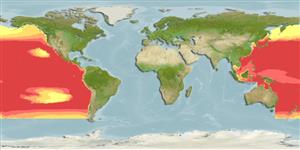
Θαλασσινό(ά); Υφάλμυρο pelagic-oceanic; ωκεανόδρομο(ς) (Ref. 51243); εύρος βάθους 1 - 550 m (Ref. 58302). Subtropical; 61°N - 52°S, 99°E - 70°W
North Pacific: Gulf of Alaska to southern California and Baja California and from Sakhalin Island in the southern Sea of Okhotsk south to northern Philippines. There are four substantiated records of this subspecies in the southern hemisphere: off Western Australia, southeast Pacific (37°11'S, 114°41'W) and Gulf of Papua (Ref. 10997). The species occurs mainly in the northern Pacific but ventures into New Zealand waters for at least three months during spring and early summer (Ref. 83312).
Μέγεθος / Βάρος / Ηλικία
Γεννητική Ωρίμανση: Lm ? range ? - ? cm
Max length : 300 cm FL αρσενικό/απροσδιόριστο; (Ref. 9340); common length : 200 cm FL αρσενικό/απροσδιόριστο; (Ref. 9340); μεγ. δημοσιευμένο βάρος: 450.0 kg (Ref. 47525); μεγ. αναφερόμενη ηλικία: 15 έτη (Ref. 83312)
Σύντομη περιγραφή
Κλείδες προσδιορισμού | Μορφολογία | Μορφομετρία
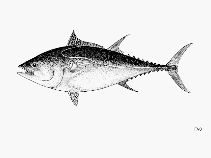
Mean number of gill rakers 35.9. First ventrally directed parapophysis on vertebra number 8. Dorsal wall of body cavity has a narrow bulge with lateral concavity and wide lateral trough. Caudal keels dark.
Body shape (shape guide): fusiform / normal.
Epipelagic, usually oceanic, but seasonally coming close to shore (Ref. 168). Tolerates ample temperature intervals (Ref. 168). Forms schools by size, sometimes with other scombrids (Ref. 168). Migrates between June and September in a northward direction along the coast of Baja California, Mexico and California (Ref. 168). A voracious predator that feeds on a wide variety of small schooling fishes and squids, also on crabs crabs and to a lesser degree on sessile organisms (Ref. 168). Marketed fresh and frozen.
Collette, B.B., 1995. Scombridae. Atunes, bacoretas, bonitos, caballas, estorninos, melva, etc. p. 1521-1543. In W. Fischer, F. Krupp, W. Schneider, C. Sommer, K.E. Carpenter and V. Niem (eds.) Guia FAO para Identification de Especies para lo Fines de la Pesca. Pacifico Centro-Oriental. 3 Vols. FAO, Rome. (Ref. 9340)
Κατάσταση Κόκκινου Καταλόγου IUCN (Ref. 130435: Version 2025-2 (Global))
Απειλή για τον άνθρωπο
Harmless
Ανθρώπινες χρήσεις
αλιεία: πολύ εμπορικό; Υδατοκαλλιέργειες: Εμπορικό(ά); αλιεία αναψυχής: ναί
Εργαλεία
Ειδικές εκθέσεις
Λήψη XML
Διαδικτυακές πηγές
Εκτιμήσεις βάσει μοντέλων
Προτιμώμενη θερμοκρασία (Αναφ.
123201): 13.9 - 28.1, mean 24.3 °C (based on 983 cells).
Δείκτης φυλογενετικής ποικιλότητας (Αναφ.
82804): PD
50 = 0.5039 [Uniqueness, from 0.5 = low to 2.0 = high].
Bayesian length-weight: a=0.01380 (0.00641 - 0.02973), b=3.03 (2.86 - 3.20), in cm total length, based on LWR estimates for this Genus-body shape (Ref.
93245).
Τροφικό Επίπεδο (Αναφ.
69278): 4.5 ±0.3 se; based on size and trophs of closest relatives
Generation time: 10.6 ( na - na) years. Estimated as median ln(3)/K based on 2
growth studies.
Ελαστικότητα (Αναφ.
120179): Μεσαίο(α), ελάχιστος χρόνος για διπλασιασμό πληθυσμού 1,4 - 4,4 έτη (K=0.15; tm=3-5; tmax=15).
Prior r = 0.25, 95% CL = 0.17 - 0.38, Based on 3 full stock assessments.
Ευπάθεια στην αλιεία (Ref.
59153): Very high vulnerability (76 of 100).
🛈
Ευπάθεια στο κλίμα (Ref.
125649): Moderate vulnerability (38 of 100).
🛈
Θρεπτικά συστατικά (Ref.
124155): Calcium = 18.3 [10.0, 32.3] mg/100g; Iron = 2.32 [0.96, 5.79] mg/100g; Protein = 24.2 [22.7, 25.5] %; Omega3 = 0.403 [0.246, 0.662] g/100g; Selenium = 42.6 [16.1, 118.0] μg/100g; VitaminA = 21.5 [2.9, 199.3] μg/100g; Zinc = 0.355 [0.211, 0.717] mg/100g (wet weight); based on
nutrient studies.