Ambiente: milieu / zona climatica / distribuzione batimetrica / gamma di distribuzione
Ecologia
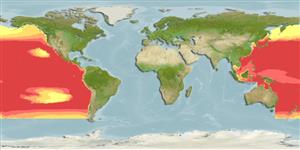
marino; salmastro pelagic-oceanic; oceanodromo (Ref. 51243); distribuzione batimetrica 1 - 550 m (Ref. 58302). Subtropical; 61°N - 52°S, 99°E - 70°W
North Pacific: Gulf of Alaska to southern California and Baja California and from Sakhalin Island in the southern Sea of Okhotsk south to northern Philippines. There are four substantiated records of this subspecies in the southern hemisphere: off Western Australia, southeast Pacific (37°11'S, 114°41'W) and Gulf of Papua (Ref. 10997). The species occurs mainly in the northern Pacific but ventures into New Zealand waters for at least three months during spring and early summer (Ref. 83312).
Dimensione / Peso / Età
Maturità: Lm ? range ? - ? cm
Max length : 300 cm FL maschio/sesso non determinato; (Ref. 9340); common length : 200 cm FL maschio/sesso non determinato; (Ref. 9340); peso massimo pubblicato: 450.0 kg (Ref. 47525); Età massima riportata: 15 anni (Ref. 83312)
Breve descrizione
Chiavi di identificazione | Morfologia | Morfometria
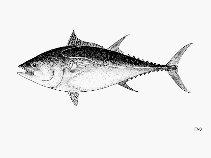
Mean number of gill rakers 35.9. First ventrally directed parapophysis on vertebra number 8. Dorsal wall of body cavity has a narrow bulge with lateral concavity and wide lateral trough. Caudal keels dark.
Body shape (shape guide): fusiform / normal.
Epipelagic, usually oceanic, but seasonally coming close to shore (Ref. 168). Tolerates ample temperature intervals (Ref. 168). Forms schools by size, sometimes with other scombrids (Ref. 168). Migrates between June and September in a northward direction along the coast of Baja California, Mexico and California (Ref. 168). A voracious predator that feeds on a wide variety of small schooling fishes and squids, also on crabs crabs and to a lesser degree on sessile organisms (Ref. 168). Marketed fresh and frozen.
Collette, B.B., 1995. Scombridae. Atunes, bacoretas, bonitos, caballas, estorninos, melva, etc. p. 1521-1543. In W. Fischer, F. Krupp, W. Schneider, C. Sommer, K.E. Carpenter and V. Niem (eds.) Guia FAO para Identification de Especies para lo Fines de la Pesca. Pacifico Centro-Oriental. 3 Vols. FAO, Rome. (Ref. 9340)
Stato della Lista Rossa IUCN (Ref. 130435: Version 2025-2 (Global))
Minaccia per l'uomo
Harmless
Usi umani
Pesca: elevato interesse commerciale; Acquacoltura: commerciale; Pesce da pesca sportiva: si
Strumenti
Rapporti speciali
Scarica XML
Fonti Internet
Stime basate su modelli
Temperatura preferita (Fonte Biblio.
123201): 13.9 - 28.1, mean 24.3 °C (based on 983 cells).
Indice di diversità filogenetica (Fonte Biblio.
82804): PD
50 = 0.5039 [Uniqueness, from 0.5 = low to 2.0 = high].
Bayesian length-weight: a=0.01380 (0.00641 - 0.02973), b=3.03 (2.86 - 3.20), in cm total length, based on LWR estimates for this Genus-body shape (Ref.
93245).
Livello trofico (Fonte Biblio.
69278): 4.5 ±0.3 se; based on size and trophs of closest relatives
Generation time: 10.6 ( na - na) years. Estimated as median ln(3)/K based on 2
growth studies.
Resilienza (Fonte Biblio.
120179): Medio, tempo minimo di raddoppiamento della popolazione 1.4 - 4.4 anni (K=0.15; tm=3-5; tmax=15).
Prior r = 0.25, 95% CL = 0.17 - 0.38, Based on 3 full stock assessments.
Vulnerabilità della pesca (Ref.
59153): Very high vulnerability (76 of 100).
🛈
Vulnerabilità climatica (Ref.
125649): Moderate vulnerability (38 of 100).
🛈
Nutrienti (Ref.
124155): Calcium = 18.3 [10.0, 32.3] mg/100g; Iron = 2.32 [0.96, 5.79] mg/100g; Protein = 24.2 [22.7, 25.5] %; Omega3 = 0.403 [0.246, 0.662] g/100g; Selenium = 42.6 [16.1, 118.0] μg/100g; VitaminA = 21.5 [2.9, 199.3] μg/100g; Zinc = 0.355 [0.211, 0.717] mg/100g (wet weight); based on
nutrient studies.