>
Clupeiformes (Herrings) >
Spratelloididae (Small round herrings)
Etymology: Spratelloides: Old German, sprotte (1611) = a small fish, Clupea sp. + Greek, suffix, oides = similar to (Ref. 45335).
More on author: Bennett.
Taxonomic Remarks
The species in the genera Spratelloides Bleeker, 1851 and Jenkinsia Jordan & Evermann, 1896 should most probably be assigned to a separated family from Clupeidae and Dussumieriidae (Lavoué, pers. comm., July 2013). See a preliminary analysis in Lavoué et al. (2013: Ref. 93878).
Περιβάλλον: περιβάλλον / κλιματική ζώνη / εύρος βάθους / εύρος διανομής
Οικολογία
Θαλασσινό(ά) Υφαλόφιλο(α); εύρος βάθους 0 - 50 m (Ref. 188). Tropical; 40°N - 29°S, 29°E - 143°W (Ref. 188)
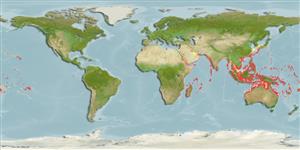
Indo-Pacific: Red Sea and East Africa to the Society Islands (but not the Tuamoto and Marquesas islands), north to southern Japan, south to northern Australia. Single specimen from eastern Mediterranean (Tel-Aviv, Israel).
Μήκος κατά την πρώτη ωρίμανση / Μέγεθος / Βάρος / Ηλικία
Γεννητική Ωρίμανση: Lm ?, range 4 - ? cm
Max length : 17.8 cm SL αρσενικό/απροσδιόριστο; (Ref. 137577)
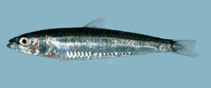
Ραχιαίες άκανθες (συνολικά) : 0; Μαλακές ραχιαίες ακτίνες (συνολικά) : 11 - 13; Εδρικές άκανθες: 0; Μαλακές εδρικές ακτίνες: 10 - 11. No bright silver along band flanks, maxilla toothless; pre-maxillae triangular, 2 supra-maxillae, second supra-maxilla paddle-shaped and symmetrical; vertical striate on scales meeting at center, posterior margin of scales smooth, pre-dorsal scales 8 to 13; W-shaped pelvic scute, few branchiostegal rays (6 or 7).
Body shape (shape guide): fusiform / normal; Cross section: oval.
Pelagic (Ref. 68964). Usually an inshore schooling species, inhabiting relatively clear coastal waters, lagoons, and along reef margins. Feeds near surface on plankton. Found in large schools (Ref. 9710). Pelagic (Ref. 58302). Marketed fresh or dried-salted (Ref. 5213) and used as tuna baitfish.
Whitehead, P.J.P., 1985. FAO Species Catalogue. Vol. 7. Clupeoid fishes of the world (suborder Clupeoidei). An annotated and illustrated catalogue of the herrings, sardines, pilchards, sprats, shads, anchovies and wolf-herrings. FAO Fish. Synop. 125(7/1):1-303. Rome: FAO. (Ref. 188)
Κατάσταση Κόκκινου Καταλόγου IUCN (Ref. 130435: Version 2025-2 (Global))
Απειλή για τον άνθρωπο
Harmless
Ανθρώπινες χρήσεις
αλιεία: περιορισμένης εμπορικότητας; δόλωμα: usually
Εργαλεία
Ειδικές εκθέσεις
Λήψη XML
Διαδικτυακές πηγές
Εκτιμήσεις βάσει μοντέλων
Προτιμώμενη θερμοκρασία (Αναφ.
123201): 24.7 - 29.1, mean 28.1 °C (based on 1228 cells).
Δείκτης φυλογενετικής ποικιλότητας (Αναφ.
82804): PD
50 = 0.5664 [Uniqueness, from 0.5 = low to 2.0 = high].
Bayesian length-weight: a=0.00479 (0.00289 - 0.00793), b=3.17 (3.03 - 3.31), in cm total length, based on LWR estimates for this species & (Sub)family-body (Ref.
93245).
Τροφικό Επίπεδο (Αναφ.
69278): 3.1 ±0.0 se; based on diet studies.
Generation time: 0.4 ( na - na) years. Estimated as median ln(3)/K based on 1
growth studies.
Ελαστικότητα (Αναφ.
120179): Υψηλό, ελάχιστος χρόνος για διπλασιασμό πληθυσμού < 15 μήνες (K=2.7-12.2; Fec=524; tm=0.14).
Ευπάθεια στην αλιεία (Ref.
59153): Low vulnerability (11 of 100).
🛈
Θρεπτικά συστατικά (Ref.
124155): Calcium = 347 [102, 2,847] mg/100g; Iron = 4.79 [1.15, 18.89] mg/100g; Protein = 19.7 [16.9, 22.4] %; Omega3 = 0.179 [0.029, 1.111] g/100g; Selenium = 223 [24, 1,690] μg/100g; VitaminA = 19 [2, 208] μg/100g; Zinc = 6.8 [2.2, 18.3] mg/100g (wet weight);