>
Clupeiformes (Herrings) >
Spratelloididae (Small round herrings)
Etymology: Spratelloides: Old German, sprotte (1611) = a small fish, Clupea sp. + Greek, suffix, oides = similar to (Ref. 45335).
More on author: Bennett.
Taxonomic Remarks
The species in the genera Spratelloides Bleeker, 1851 and Jenkinsia Jordan & Evermann, 1896 should most probably be assigned to a separated family from Clupeidae and Dussumieriidae (Lavoué, pers. comm., July 2013). See a preliminary analysis in Lavoué et al. (2013: Ref. 93878).
Entorno: milieu / zona climática / rango de profundidad / gama de distribución
Ecología
marino asociado a arrecife; rango de profundidad 0 - 50 m (Ref. 188). Tropical; 40°N - 29°S, 29°E - 143°W (Ref. 188)
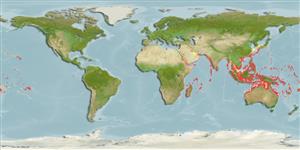
Indo-Pacific: Red Sea and East Africa to the Society Islands (but not the Tuamoto and Marquesas islands), north to southern Japan, south to northern Australia. Single specimen from eastern Mediterranean (Tel-Aviv, Israel).
Longitud en la primera madurez / Tamaño / Peso / Edad
Madurez: Lm ?, range 4 - ? cm
Max length : 17.8 cm SL macho / no sexado; (Ref. 137577)
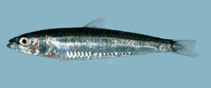
Espinas dorsales (total) : 0; Radios blandos dorsales (total) : 11 - 13; Espinas anales: 0; Radios blandos anales: 10 - 11. No bright silver along band flanks, maxilla toothless; pre-maxillae triangular, 2 supra-maxillae, second supra-maxilla paddle-shaped and symmetrical; vertical striate on scales meeting at center, posterior margin of scales smooth, pre-dorsal scales 8 to 13; W-shaped pelvic scute, few branchiostegal rays (6 or 7).
Body shape (shape guide): fusiform / normal; Cross section: oval.
Pelagic (Ref. 68964). Usually an inshore schooling species, inhabiting relatively clear coastal waters, lagoons, and along reef margins. Feeds near surface on plankton. Found in large schools (Ref. 9710). Pelagic (Ref. 58302). Marketed fresh or dried-salted (Ref. 5213) and used as tuna baitfish.
Whitehead, P.J.P., 1985. FAO Species Catalogue. Vol. 7. Clupeoid fishes of the world (suborder Clupeoidei). An annotated and illustrated catalogue of the herrings, sardines, pilchards, sprats, shads, anchovies and wolf-herrings. FAO Fish. Synop. 125(7/1):1-303. Rome: FAO. (Ref. 188)
Situación en la Lista Roja de la UICN (Ref. 130435: Version 2025-2 (Global))
Amenaza para el ser humano
Harmless
Usos humanos
Pesquerías: escaso valor comercial; carnada: usually
Herramientas
Informes especiales
Descargar XML
Fuentes de Internet
Estimaciones basadas en modelos
Temperatura preferida (Referencia
123201): 24.7 - 29.1, mean 28.1 °C (based on 1228 cells).
Índice de diversidad filogenética (Referencia
82804): PD
50 = 0.5664 [Uniqueness, from 0.5 = low to 2.0 = high].
Bayesian length-weight: a=0.00479 (0.00289 - 0.00793), b=3.17 (3.03 - 3.31), in cm total length, based on LWR estimates for this species & (Sub)family-body (Ref.
93245).
Nivel trófico (Referencia
69278): 3.1 ±0.0 se; based on diet studies.
Generation time: 0.4 ( na - na) years. Estimated as median ln(3)/K based on 1
growth studies.
Resiliencia (Referencia
120179): Alto, población duplicada en un tiempo mínimo inferior a 15 meses (K=2.7-12.2; Fec=524; tm=0.14).
Vulnerabilidad pesquera (Ref.
59153): Low vulnerability (11 of 100).
🛈
Nutrientes (Ref.
124155): Calcium = 347 [102, 2,847] mg/100g; Iron = 4.79 [1.15, 18.89] mg/100g; Protein = 19.7 [16.9, 22.4] %; Omega3 = 0.179 [0.029, 1.111] g/100g; Selenium = 223 [24, 1,690] μg/100g; VitaminA = 19 [2, 208] μg/100g; Zinc = 6.8 [2.2, 18.3] mg/100g (wet weight);