>
Eupercaria/misc (Various families in series Eupercaria) >
Sparidae (Porgies)
Etymology: Acanthopagrus: Greek, akantha = thorn + Greek, pagros, a kind of fish (Ref. 45335).
Eponymy: Alfred Dunbavin Butcher (1915–1990) was an Australian zoologist. [...] (Ref. 128868), visit book page.
Environnement : milieu / zone climatique / profondeur / gamme de distribution
Écologie
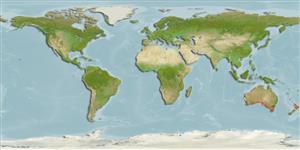
marin; eau douce; saumâtre démersal. Subtropical; 25°S - 44°S, 112°E - 154°E
Indo-Pacific: endemic to southern Australia.
Longueur à la première maturité / Taille / Poids / Âge
Maturité: Lm ?, range 16 - ? cm
Max length : 60.0 cm TL mâle / non sexé; (Ref. 2156); common length : 24.0 cm TL mâle / non sexé; (Ref. 2156); poids max. publié: 4.0 kg (Ref. 26523); âge max. reporté: 29 années (Ref. 36820)
Description synthétique
Clés d'identification | Morphologie | Morphométrie
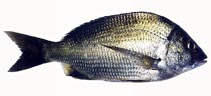
Épines dorsales (Total) : 10 - 13; Rayons mous dorsaux (Total) : 10 - 13; Épines anales: 3; Rayons mous anaux: 8 - 10. The upper body can vary from silvery to golden brown, bronze, green or black depending on habitat. Chin and belly are usually white and fins are dusky to greenish black. Dorsal and ventral profiles of adults are similarly convex.
Body shape (shape guide): fusiform / normal; Cross section: compressed.
Endemic in coastal areas, rivers and estuaries of Australia. Most abundant in river mouths and estuaries (Ref. 28468, 28472). Inhabit brackish waters of coastal rivers and lakes, occasionally penetrating fresh water (Ref. 44894). Considered as the only true estuarine sparid in Australia. Larvae and small juveniles are most abundant over seagrass beds in shallow estuarine waters (Ref. 28468, 28472). Spawning period varies considerably between estuaries (Ref. 28468). Remain upstream in sheltered waters to spawn and is not usually found in purely marine habitats (Ref. 44894). Feed on shellfish, worms, crustaceans, small fish and algae. Sold as whole, chilled products in domestic markets (Ref. 6390). One of top angling species in southern Australia (Ref. 6390, 44894), as well as being a delicious table fish (Ref. 2156).
It is not known whether there is any sex inversion in black bream (Ref. 6390).
Kailola, P.J., M.J. Williams, P.C. Stewart, R.E. Reichelt, A. McNee and C. Grieve, 1993. Australian fisheries resources. Bureau of Resource Sciences, Canberra, Australia. 422 p. (Ref. 6390)
Statut dans la liste rouge de l'IUCN (Ref. 130435: Version 2025-2 (Global))
Menace pour l'homme
Harmless
Utilisations par l'homme
Pêcheries: commercial; pêche sportive: oui
Outils
Articles particuliers
Télécharger en XML
Sources Internet
Estimations basées sur des modèles
Température préférée (Réf.
123201): 14.7 - 20.6, mean 17.6 °C (based on 126 cells).
Indice de diversité phylogénétique (Réf.
82804): PD
50 = 0.5000 [Uniqueness, from 0.5 = low to 2.0 = high].
Bayesian length-weight: a=0.01259 (0.01139 - 0.01391), b=3.03 (3.00 - 3.06), in cm total length, based on LWR estimates for this species (Ref.
93245).
Niveau trophique (Réf.
69278): 3.5 ±0.53 se; based on food items.
Generation time: 4.1 (3.7 - 6.9) years. Estimated as median ln(3)/K based on 16
growth studies.
Résilience (Réf.
120179): Faible, temps minimum de doublement de population : 4,5 à 14 années (K=0.11; tm=2-5; tmax=29).
Vulnérabilité de la pêche (Ref.
59153): Moderate vulnerability (41 of 100).
🛈
Nutriments (Ref.
124155): Calcium = 76.4 [42.1, 142.3] mg/100g; Iron = 1.07 [0.62, 1.89] mg/100g; Protein = 20 [19, 21] %; Omega3 = 0.36 [0.25, 0.57] g/100g; Selenium = 21.1 [10.4, 38.9] μg/100g; VitaminA = 9.49 [3.31, 24.31] μg/100g; Zinc = 0.832 [0.594, 1.137] mg/100g (wet weight);