>
Blenniiformes (Blennies) >
Labrisomidae (Labrisomids)
Etymology: Malacoctenus: Greek, malakos = soft + Greek, kteis, ktenos = comb (Ref. 45335).
Eponymy: Donald S Erdman was an American ichthyologist, fishery biologist and angler. [...] (Ref. 128868), visit book page.
Umwelt: Milieu / Klimazone / Tiefenbereich / Verbreitungsgebiet
Ökologie
seewasser riff-verbunden. Tropical
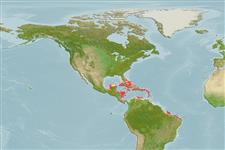
Western Atlantic: Bahamas to Curaçao.
Größe / Gewicht / Alter
Geschlechtsreife: Lm ? range ? - ? cm
Max length : 3.8 cm TL Männchen/unbestimmt; (Ref. 5521)
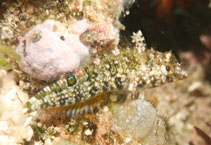
Rückenflossenweichstrahlen (insgesamt) : 7 - 37; Afterflossenstacheln: 2. Common amongst Labrisomids: small, often elongate fishes; largest species about 20 cm standard length, most under 10 cm standard length. Head usually with cirri or fleshy flaps on anterior nostrils, eyes, and laterally on nape; gill membranes continuous with each other across posteroventral surface of head. Each jaw with an outer row of relatively large, canine-like or incisor-like teeth, often with patches of smaller teeth behind; teeth usually also present on vomer. Dorsal and anal fins long, frequently highest anteriorly; dorsal-fin spines often flexible, outnumbering segmented dorsal-fin soft rays; 2 usually flexible spines in anal fin; pelvic fins inserted anterior to pectoral-fin bases, with 1 spine not visible externally; all fin rays, including those of caudal, unbranched (simple). Cycloid (smooth to touch) scales present at least posteriorly on body. Body coloration: varying from drab to brilliant hues; usually with irregular vertical bands, spots, or marbled pattern. Species distinguished by: dorsal fin consisting of spines and 7 to 37 segmented rays; cirri on anterior nostril and bove eye usually 2; two or more cirri on each side of nape just anterior to dorsal-fin origin; pectoral-fin rays usually 16; length of shortest pelvic-fin ray (third ray very difficult to see) contained fewer than 4 times in length of longest ray; pelvic-fin soft rays 3 (innermost ray may be reduced in length and folded over middle ray); scales in lateral-line series 40 to 69 (some scales in posterior portion of lateral line may lack sensory tubes, but are included in count); pectoral-fin base naked; maxillary bone sheathed; small teeth present behind large teeth in outer row (small teeth inconspicuous and easily knocked out while probing); teeth absent on palatines; distinct, dark blotch at bases of posteriormost dorsal-fin spines (Ref.52855).
Body shape (shape guide): elongated.
Inhabits surfaces of rocks, in depressions, and among clumps of algae, among broken coral debris and rocks in only a few feet of water (Ref. 5521).
Lebenszyklus und Paarungsverhalten
Geschlechtsreife | Fortpflanzung | Ablaichen | Eier | Fruchtbarkeit | Larven
Böhlke, J.E. and C.C.G. Chaplin, 1993. Fishes of the Bahamas and adjacent tropical waters. 2nd edition. University of Texas Press, Austin. (Ref. 5521)
IUCN Rote Liste Status (Ref. 130435: Version 2025-2 (Global))
Bedrohung für Menschen
Harmless
Nutzung durch Menschen
Tools
Zusatzinformationen
Download XML
Internet Quellen
Schätzungen auf der Grundlage von Modellen
Bevorzugte Temperatur (Ref.
123201): 26.5 - 28.2, mean 27.5 °C (based on 549 cells).
Phylogenetischer Diversitätsindex (Ref.
82804): PD
50 = 0.5000 [Uniqueness, from 0.5 = low to 2.0 = high].
Bayesian length-weight: a=0.00525 (0.00218 - 0.01265), b=3.08 (2.86 - 3.30), in cm total length, based on LWR estimates for this (Sub)family-body shape (Ref.
93245).
Trophische Ebene (Ref.
69278): 3.2 ±0.4 se; based on size and trophs of closest relatives
Anfälligkeit der Fischerei (Ref.
59153): Low vulnerability (10 of 100).
🛈
Nährstoffe (Ref.
124155): Calcium = 209 [89, 394] mg/100g; Iron = 0.834 [0.437, 1.543] mg/100g; Protein = 18.1 [16.8, 19.2] %; Omega3 = 0.113 [0.054, 0.225] g/100g; Selenium = 17.5 [6.2, 44.9] μg/100g; VitaminA = 328 [89, 1,219] μg/100g; Zinc = 2.7 [1.6, 4.1] mg/100g (wet weight);