>
Blenniiformes (Blennies) >
Labrisomidae (Labrisomids)
Etymology: Malacoctenus: Greek, malakos = soft + Greek, kteis, ktenos = comb (Ref. 45335).
Eponymy: Donald S Erdman was an American ichthyologist, fishery biologist and angler. [...] (Ref. 128868), visit book page.
Môi trường: môi trường / vùng khí hậu / Mức độ sâu / phạm vi phân phối
Sinh thái học
biển cùng sống ở rạn san hô. Tropical
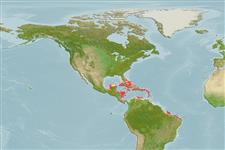
Western Atlantic: Bahamas to Curaçao.
Bộ gần gũi / Khối lượng (Trọng lượng) / Tuổi
Chín muồi sinh dục: Lm ? range ? - ? cm
Max length : 3.8 cm TL con đực/không giới tính; (Ref. 5521)
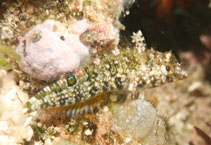
Các vây lưng mềm (tổng cộng) : 7 - 37; Tia cứng vây hậu môn: 2. Common amongst Labrisomids: small, often elongate fishes; largest species about 20 cm standard length, most under 10 cm standard length. Head usually with cirri or fleshy flaps on anterior nostrils, eyes, and laterally on nape; gill membranes continuous with each other across posteroventral surface of head. Each jaw with an outer row of relatively large, canine-like or incisor-like teeth, often with patches of smaller teeth behind; teeth usually also present on vomer. Dorsal and anal fins long, frequently highest anteriorly; dorsal-fin spines often flexible, outnumbering segmented dorsal-fin soft rays; 2 usually flexible spines in anal fin; pelvic fins inserted anterior to pectoral-fin bases, with 1 spine not visible externally; all fin rays, including those of caudal, unbranched (simple). Cycloid (smooth to touch) scales present at least posteriorly on body. Body coloration: varying from drab to brilliant hues; usually with irregular vertical bands, spots, or marbled pattern. Species distinguished by: dorsal fin consisting of spines and 7 to 37 segmented rays; cirri on anterior nostril and bove eye usually 2; two or more cirri on each side of nape just anterior to dorsal-fin origin; pectoral-fin rays usually 16; length of shortest pelvic-fin ray (third ray very difficult to see) contained fewer than 4 times in length of longest ray; pelvic-fin soft rays 3 (innermost ray may be reduced in length and folded over middle ray); scales in lateral-line series 40 to 69 (some scales in posterior portion of lateral line may lack sensory tubes, but are included in count); pectoral-fin base naked; maxillary bone sheathed; small teeth present behind large teeth in outer row (small teeth inconspicuous and easily knocked out while probing); teeth absent on palatines; distinct, dark blotch at bases of posteriormost dorsal-fin spines (Ref.52855).
Body shape (shape guide): elongated.
Inhabits surfaces of rocks, in depressions, and among clumps of algae, among broken coral debris and rocks in only a few feet of water (Ref. 5521).
Vòng đời và hành vi giao phối
Chín muồi sinh dục | Sự tái sinh sản | Đẻ trứng | Các trứng | Sự sinh sản | Ấu trùng
Böhlke, J.E. and C.C.G. Chaplin, 1993. Fishes of the Bahamas and adjacent tropical waters. 2nd edition. University of Texas Press, Austin. (Ref. 5521)
Tình trạng Sách đỏ IUCN (Ref. 130435: Version 2025-2 (Global))
Mối đe dọa đối với con người
Harmless
Sử dụng của con người
Các công cụ
Báo cáo đặc biệt
Tải xuống XML
Các nguồn internet
Ước tính dựa trên mô hình
Nhiệt độ ưa thích (Tài liệu tham khảo
123201): 26.5 - 28.2, mean 27.5 °C (based on 549 cells).
Chỉ số đa dạng phát sinh loài (Tài liệu tham khảo
82804): PD
50 = 0.5000 [Uniqueness, from 0.5 = low to 2.0 = high].
Bayesian length-weight: a=0.00525 (0.00218 - 0.01265), b=3.08 (2.86 - 3.30), in cm total length, based on LWR estimates for this (Sub)family-body shape (Ref.
93245).
Mức dinh dưỡng (Tài liệu tham khảo
69278): 3.2 ±0.4 se; based on size and trophs of closest relatives
Sự dễ bị tổn thương của nghề đánh cá (Ref.
59153): Low vulnerability (10 of 100).
🛈
Chất dinh dưỡng (Ref.
124155): Calcium = 209 [89, 394] mg/100g; Iron = 0.834 [0.437, 1.543] mg/100g; Protein = 18.1 [16.8, 19.2] %; Omega3 = 0.113 [0.054, 0.225] g/100g; Selenium = 17.5 [6.2, 44.9] μg/100g; VitaminA = 328 [89, 1,219] μg/100g; Zinc = 2.7 [1.6, 4.1] mg/100g (wet weight);