>
Blenniiformes (Blennies) >
Labrisomidae (Labrisomids)
Etymology: Malacoctenus: Greek, malakos = soft + Greek, kteis, ktenos = comb (Ref. 45335).
Eponymy: Donald S Erdman was an American ichthyologist, fishery biologist and angler. [...] (Ref. 128868), visit book page.
Meio ambiente: milieu / Zona climática / intervalo de profundidade / faixa de distribuição
Ecologia
marinhas associadas(os) a recifes. Tropical
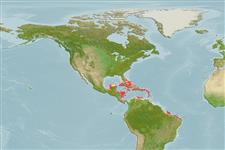
Western Atlantic: Bahamas to Curaçao.
Tamanho / Peso / Idade
Maturidade: Lm ? range ? - ? cm
Max length : 3.8 cm TL macho/indeterminado; (Ref. 5521)
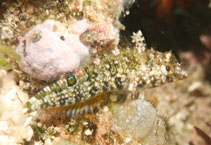
Raios dorsais (total) : 7 - 37; Espinhos anais: 2. Common amongst Labrisomids: small, often elongate fishes; largest species about 20 cm standard length, most under 10 cm standard length. Head usually with cirri or fleshy flaps on anterior nostrils, eyes, and laterally on nape; gill membranes continuous with each other across posteroventral surface of head. Each jaw with an outer row of relatively large, canine-like or incisor-like teeth, often with patches of smaller teeth behind; teeth usually also present on vomer. Dorsal and anal fins long, frequently highest anteriorly; dorsal-fin spines often flexible, outnumbering segmented dorsal-fin soft rays; 2 usually flexible spines in anal fin; pelvic fins inserted anterior to pectoral-fin bases, with 1 spine not visible externally; all fin rays, including those of caudal, unbranched (simple). Cycloid (smooth to touch) scales present at least posteriorly on body. Body coloration: varying from drab to brilliant hues; usually with irregular vertical bands, spots, or marbled pattern. Species distinguished by: dorsal fin consisting of spines and 7 to 37 segmented rays; cirri on anterior nostril and bove eye usually 2; two or more cirri on each side of nape just anterior to dorsal-fin origin; pectoral-fin rays usually 16; length of shortest pelvic-fin ray (third ray very difficult to see) contained fewer than 4 times in length of longest ray; pelvic-fin soft rays 3 (innermost ray may be reduced in length and folded over middle ray); scales in lateral-line series 40 to 69 (some scales in posterior portion of lateral line may lack sensory tubes, but are included in count); pectoral-fin base naked; maxillary bone sheathed; small teeth present behind large teeth in outer row (small teeth inconspicuous and easily knocked out while probing); teeth absent on palatines; distinct, dark blotch at bases of posteriormost dorsal-fin spines (Ref.52855).
Body shape (shape guide): elongated.
Inhabits surfaces of rocks, in depressions, and among clumps of algae, among broken coral debris and rocks in only a few feet of water (Ref. 5521).
Ciclo de vida ou comportamento de acasalamento
Maturidade | Reprodução | Desova | Ovos | Fecundidade | Larvas
Böhlke, J.E. and C.C.G. Chaplin, 1993. Fishes of the Bahamas and adjacent tropical waters. 2nd edition. University of Texas Press, Austin. (Ref. 5521)
Status na Lista Vermelha da UICN (Ref. 130435: Version 2025-2 (Global))
Ameaça para os humanos
Harmless
Uso pelos humanos
Ferramentas
Relatórios especiais
Baixar XML
Fontes da internet
Estimativas baseadas em modelos
Temperatura preferida (Ref.
123201): 26.5 - 28.2, mean 27.5 °C (based on 549 cells).
Índice de diversidade filogenética (Ref.
82804): PD
50 = 0.5000 [Uniqueness, from 0.5 = low to 2.0 = high].
Bayesian length-weight: a=0.00525 (0.00218 - 0.01265), b=3.08 (2.86 - 3.30), in cm total length, based on LWR estimates for this (Sub)family-body shape (Ref.
93245).
Nível Trófico (Ref.
69278): 3.2 ±0.4 se; based on size and trophs of closest relatives
Vulnerabilidade da pesca (Ref.
59153): Low vulnerability (10 of 100).
🛈
Nutrientes (Ref.
124155): Calcium = 209 [89, 394] mg/100g; Iron = 0.834 [0.437, 1.543] mg/100g; Protein = 18.1 [16.8, 19.2] %; Omega3 = 0.113 [0.054, 0.225] g/100g; Selenium = 17.5 [6.2, 44.9] μg/100g; VitaminA = 328 [89, 1,219] μg/100g; Zinc = 2.7 [1.6, 4.1] mg/100g (wet weight);