>
Carangiformes (Jacks) >
Carangidae (Jacks and pompanos) > Scomberoidinae
Etymology: Scomberoides: Greek, skombros = tunny or mackerel, 1623 + Greek, oides = similar to (Ref. 45335).
Eponymy: Dr Philibert Commerson (1727–1773) was known as ‘doctor, botanist and naturalist of the King’. [...] (Ref. 128868), visit book page.
More on author: Lacepède.
Umwelt: Milieu / Klimazone / Tiefenbereich / Verbreitungsgebiet
Ökologie
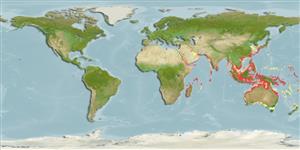
seewasser; brackwasser riff-verbunden; amphidrom (Ref. 51243); tiefenbereich ? - 50 m (Ref. 86942). Tropical; 35°N - 42°S, 25°E - 179°E
Indo-West Pacific.
Länge bei der ersten Reifung / Größe / Gewicht / Alter
Geschlechtsreife: Lm 63.5 range ? - ? cm
Max length : 120 cm TL Männchen/unbestimmt; (Ref. 3287); common length : 90.0 cm FL Männchen/unbestimmt; (Ref. 5288); max. veröff. Gewicht: 16.0 kg (Ref. 40637)
Rückenflossenstacheln (insgesamt) : 7 - 8; Rückenflossenweichstrahlen (insgesamt) : 19 - 21; Afterflossenstacheln: 3; Afterflossenweichstrahlen: 16 - 19.
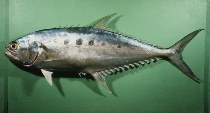
Body shape (shape guide): fusiform / normal; Cross section: compressed.
Adults inhabit coastal waters, frequently near reefs and offshore islands (Ref. 30573, 48635). Occasionally found in estuaries. Usually in small groups (Ref. 9710, 48635). Feed on fishes, cephalopods, small invertebrates and, other pelagic prey (Ref. 5213, 90102).
Paxton, J.R., D.F. Hoese, G.R. Allen and J.E. Hanley, 1989. Pisces. Petromyzontidae to Carangidae. Zoological Catalogue of Australia, Vol. 7. Australian Government Publishing Service, Canberra, 665 p. (Ref. 7300)
IUCN Rote Liste Status (Ref. 130435: Version 2025-2 (Global))
Bedrohung für Menschen
Harmless
Nutzung durch Menschen
Fischereien: weniger kommerziell; Sportfisch: ja
Tools
Zusatzinformationen
Download XML
Internet Quellen
Schätzungen auf der Grundlage von Modellen
Bevorzugte Temperatur (Ref.
123201): 24.2 - 29.1, mean 28.1 °C (based on 1430 cells).
Phylogenetischer Diversitätsindex (Ref.
82804): PD
50 = 0.5625 [Uniqueness, from 0.5 = low to 2.0 = high].
Bayesian length-weight: a=0.01096 (0.00725 - 0.01658), b=2.92 (2.80 - 3.04), in cm total length, based on LWR estimates for this species & (Sub)family-body (Ref.
93245).
Trophische Ebene (Ref.
69278): 4.4 ±0.45 se; based on food items.
Widerstandsfähigkeit (Ref.
120179): mittel, Verdopplung der Population dauert 1,4 - 4,4 Jahre. (K=0.24; tm=2-5; tmax=11).
Prior r = 0.28, 95% CL = 0.19 - 0.42, Based on 3 data-limited stock assessments.
Anfälligkeit der Fischerei (Ref.
59153): High vulnerability (63 of 100).
🛈
Klimaanfälligkeit (Ref.
125649): High to very high vulnerability (69 of 100).
🛈
Nährstoffe (Ref.
124155): Calcium = 28.1 [14.9, 51.7] mg/100g; Iron = 0.541 [0.300, 1.006] mg/100g; Protein = 20.3 [19.2, 21.5] %; Omega3 = 0.144 [0.094, 0.230] g/100g; Selenium = 38.3 [21.0, 66.7] μg/100g; VitaminA = 45.3 [12.3, 149.9] μg/100g; Zinc = 0.87 [0.61, 1.20] mg/100g (wet weight);