>
Gobiiformes (Gobies) >
Gobiidae (Gobies) > Gobionellinae
Etymology: Gnatholepis: Greek, gnathos = jaw + Greek,lepis = scale (Ref. 45335).
Eponymy: Commander Joseph Cheesman ‘Snake’ Thompson (1874–1943) was a US Navy medical officer (retired 1929) and amateur herpetologist. [...] (Ref. 128868), visit book page.
More on author: Jordan.
Milieu: milieu / Klimaatzone / Diepte / verspreidingsgebied
Ecologie
marien rifbewoner; diepte 0 - 50 m (Ref. 5299), usually 1 - 36 m (Ref. 92171). Tropical; 43°N - 2°S
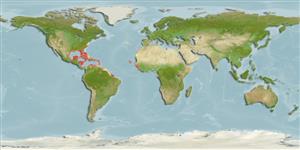
Atlantic: southern Florida, North Carolina, the Bahamas, Bermuda through to the Lesser Antilles in western Atlantic; also in the oceanic islands of Ascension, Madeira and St Helena, and Sao Tome Island, Cape Verde Islands and the Canary Islands in the eastern Atlantic.
Grootte / Gewicht / Leeftijd
Maturiteit: Lm ? range ? - ? cm
Max length : 8.2 cm TL mannelijk / geslacht onbekend; (Ref. 39517); 5.7 cm TL (female)
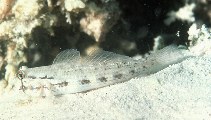
Dorsale stekels (totaal) : 7; Dorsale zachte stralen (totaal) : 10 - 12; Anale stekels: 1; Anale zachte stralen: 11. Distinguished by the following characteristics: moderately large Gnatholepis (up to 58 mm SL) with nape midline scales always cycloid and most of predorsal scales cycloid; body pale with 6-8 rows of staggered dark brown spots, mid-lateral spots may be largest; transverse black line on the upper part of the eye joining somewhat oblique to curved black line or bar crossing cheek and ending well behind end of jaw; third to fourth first dorsal fin spines longest, fin with square to rectangular appearance when extended; second dorsal and anal fin rays usually I,11; pectoral rays 16-18, usually 17; lateral scales 26-29, usually 27; 9-11 predorsal scales (usually 10), all cycloid (Ref. 92171).
Body shape (shape guide): fusiform / normal.
Inhabits open sand, rock, and rubble areas. Often occurs with the bridled goby, Coryphopterus glaucofraenum. Feeds on organisms and organic material by taking sand into its mouth and expelling it through the gill openings, filtering out its food in the process (Ref. 26938).
Levenscyclus en paargedrag
Maturiteit | Voortplanting | Paaien | Eieren | Fecunditeit | Larven
Robins, C.R. and G.C. Ray, 1986. A field guide to Atlantic coast fishes of North America. Houghton Mifflin Company, Boston, U.S.A. 354 p. (Ref. 7251)
Status op de Rode Lijst van het IUCN (Ref. 130435: Version 2025-2 (Global))
Gevaar voor de mens
Harmless
Gebruik door de mens
Visserij: commercieel; Aquarium: Commercieel
Tools
Speciale rapporten
Download XML
Internetbronnen
Schattingen op basis van modellen
Gewenste temperatuur (Ref.
123201): 23.5 - 28, mean 26.5 °C (based on 290 cells).
Fylogenetische diversiteitsindex (Ref.
82804): PD
50 = 0.5010 [Uniqueness, from 0.5 = low to 2.0 = high].
Bayesian length-weight: a=0.00871 (0.00471 - 0.01609), b=3.21 (3.05 - 3.37), in cm total length, based on LWR estimates for this species & (Sub)family-body (Ref.
93245).
Trofisch niveau (Ref.
69278): 2.3 ±0.2 se; based on diet studies.
Weerstandsvermogen (Ref.
120179): Hoog, minimale populatieverdubbelingstijd minder dan 15 maanden (Preliminary K or Fecundity.).
Kwetsbaarheid van de visserij (Ref.
59153): Low vulnerability (10 of 100).
🛈
Voedingsstoffen (Ref.
124155): Calcium = 145 [76, 299] mg/100g; Iron = 0.966 [0.480, 1.800] mg/100g; Protein = 18 [16, 20] %; Omega3 = 0.145 [0.067, 0.263] g/100g; Selenium = 27 [14, 56] μg/100g; VitaminA = 110 [28, 389] μg/100g; Zinc = 2.52 [1.66, 3.76] mg/100g (wet weight);