>
Gobiiformes (Gobies) >
Gobiidae (Gobies) > Gobionellinae
Etymology: Gnatholepis: Greek, gnathos = jaw + Greek,lepis = scale (Ref. 45335).
Eponymy: Commander Joseph Cheesman ‘Snake’ Thompson (1874–1943) was a US Navy medical officer (retired 1929) and amateur herpetologist. [...] (Ref. 128868), visit book page.
More on author: Jordan.
Entorno: milieu / zona climática / rango de profundidad / gama de distribución
Ecología
marino asociado a arrecife; rango de profundidad 0 - 50 m (Ref. 5299), usually 1 - 36 m (Ref. 92171). Tropical; 43°N - 2°S
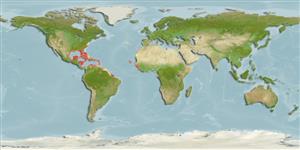
Atlantic: southern Florida, North Carolina, the Bahamas, Bermuda through to the Lesser Antilles in western Atlantic; also in the oceanic islands of Ascension, Madeira and St Helena, and Sao Tome Island, Cape Verde Islands and the Canary Islands in the eastern Atlantic.
Tamaño / Peso / Edad
Madurez: Lm ? range ? - ? cm
Max length : 8.2 cm TL macho / no sexado; (Ref. 39517); 5.7 cm TL (female)
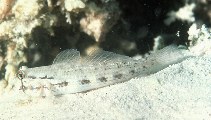
Espinas dorsales (total) : 7; Radios blandos dorsales (total) : 10 - 12; Espinas anales: 1; Radios blandos anales: 11. Distinguished by the following characteristics: moderately large Gnatholepis (up to 58 mm SL) with nape midline scales always cycloid and most of predorsal scales cycloid; body pale with 6-8 rows of staggered dark brown spots, mid-lateral spots may be largest; transverse black line on the upper part of the eye joining somewhat oblique to curved black line or bar crossing cheek and ending well behind end of jaw; third to fourth first dorsal fin spines longest, fin with square to rectangular appearance when extended; second dorsal and anal fin rays usually I,11; pectoral rays 16-18, usually 17; lateral scales 26-29, usually 27; 9-11 predorsal scales (usually 10), all cycloid (Ref. 92171).
Body shape (shape guide): fusiform / normal.
Inhabits open sand, rock, and rubble areas. Often occurs with the bridled goby, Coryphopterus glaucofraenum. Feeds on organisms and organic material by taking sand into its mouth and expelling it through the gill openings, filtering out its food in the process (Ref. 26938).
Ciclo vital y comportamiento de apareamiento
Madurez | Reproducción | Puesta | Huevos | Fecundidad | Larva
Robins, C.R. and G.C. Ray, 1986. A field guide to Atlantic coast fishes of North America. Houghton Mifflin Company, Boston, U.S.A. 354 p. (Ref. 7251)
Situación en la Lista Roja de la UICN (Ref. 130435: Version 2025-2 (Global))
Amenaza para el ser humano
Harmless
Usos humanos
Pesquerías: comercial; Acuario: Comercial
Herramientas
Informes especiales
Descargar XML
Fuentes de Internet
Estimaciones basadas en modelos
Temperatura preferida (Referencia
123201): 23.5 - 28, mean 26.5 °C (based on 290 cells).
Índice de diversidad filogenética (Referencia
82804): PD
50 = 0.5010 [Uniqueness, from 0.5 = low to 2.0 = high].
Bayesian length-weight: a=0.00871 (0.00471 - 0.01609), b=3.21 (3.05 - 3.37), in cm total length, based on LWR estimates for this species & (Sub)family-body (Ref.
93245).
Nivel trófico (Referencia
69278): 2.3 ±0.2 se; based on diet studies.
Resiliencia (Referencia
120179): Alto, población duplicada en un tiempo mínimo inferior a 15 meses (Preliminary K or Fecundity.).
Vulnerabilidad pesquera (Ref.
59153): Low vulnerability (10 of 100).
🛈
Nutrientes (Ref.
124155): Calcium = 145 [76, 299] mg/100g; Iron = 0.966 [0.480, 1.800] mg/100g; Protein = 18 [16, 20] %; Omega3 = 0.145 [0.067, 0.263] g/100g; Selenium = 27 [14, 56] μg/100g; VitaminA = 110 [28, 389] μg/100g; Zinc = 2.52 [1.66, 3.76] mg/100g (wet weight);