>
Gobiiformes (Gobies) >
Gobiidae (Gobies) > Gobionellinae
Etymology: Gnatholepis: Greek, gnathos = jaw + Greek,lepis = scale (Ref. 45335).
Eponymy: Commander Joseph Cheesman ‘Snake’ Thompson (1874–1943) was a US Navy medical officer (retired 1929) and amateur herpetologist. [...] (Ref. 128868), visit book page.
More on author: Jordan.
Môi trường: môi trường / vùng khí hậu / Mức độ sâu / phạm vi phân phối
Sinh thái học
biển cùng sống ở rạn san hô; mức độ sâu 0 - 50 m (Ref. 5299), usually 1 - 36 m (Ref. 92171). Tropical; 43°N - 2°S
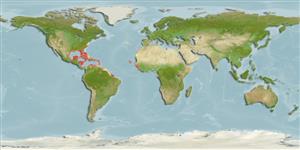
Atlantic: southern Florida, North Carolina, the Bahamas, Bermuda through to the Lesser Antilles in western Atlantic; also in the oceanic islands of Ascension, Madeira and St Helena, and Sao Tome Island, Cape Verde Islands and the Canary Islands in the eastern Atlantic.
Bộ gần gũi / Khối lượng (Trọng lượng) / Tuổi
Chín muồi sinh dục: Lm ? range ? - ? cm
Max length : 8.2 cm TL con đực/không giới tính; (Ref. 39517); 5.7 cm TL (female)
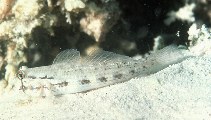
Các tia vây lưng cứng (tổng cộng) : 7; Các vây lưng mềm (tổng cộng) : 10 - 12; Tia cứng vây hậu môn: 1; Tia mềm vây hậu môn: 11. Distinguished by the following characteristics: moderately large Gnatholepis (up to 58 mm SL) with nape midline scales always cycloid and most of predorsal scales cycloid; body pale with 6-8 rows of staggered dark brown spots, mid-lateral spots may be largest; transverse black line on the upper part of the eye joining somewhat oblique to curved black line or bar crossing cheek and ending well behind end of jaw; third to fourth first dorsal fin spines longest, fin with square to rectangular appearance when extended; second dorsal and anal fin rays usually I,11; pectoral rays 16-18, usually 17; lateral scales 26-29, usually 27; 9-11 predorsal scales (usually 10), all cycloid (Ref. 92171).
Body shape (shape guide): fusiform / normal.
Inhabits open sand, rock, and rubble areas. Often occurs with the bridled goby, Coryphopterus glaucofraenum. Feeds on organisms and organic material by taking sand into its mouth and expelling it through the gill openings, filtering out its food in the process (Ref. 26938).
Vòng đời và hành vi giao phối
Chín muồi sinh dục | Sự tái sinh sản | Đẻ trứng | Các trứng | Sự sinh sản | Ấu trùng
Robins, C.R. and G.C. Ray, 1986. A field guide to Atlantic coast fishes of North America. Houghton Mifflin Company, Boston, U.S.A. 354 p. (Ref. 7251)
Tình trạng Sách đỏ IUCN (Ref. 130435: Version 2025-2 (Global))
Mối đe dọa đối với con người
Harmless
Sử dụng của con người
Các nghề cá: tính thương mại; Bể nuôi cá: Tính thương mại
Các công cụ
Báo cáo đặc biệt
Tải xuống XML
Các nguồn internet
Ước tính dựa trên mô hình
Nhiệt độ ưa thích (Tài liệu tham khảo
123201): 23.5 - 28, mean 26.5 °C (based on 290 cells).
Chỉ số đa dạng phát sinh loài (Tài liệu tham khảo
82804): PD
50 = 0.5010 [Uniqueness, from 0.5 = low to 2.0 = high].
Bayesian length-weight: a=0.00871 (0.00471 - 0.01609), b=3.21 (3.05 - 3.37), in cm total length, based on LWR estimates for this species & (Sub)family-body (Ref.
93245).
Mức dinh dưỡng (Tài liệu tham khảo
69278): 2.3 ±0.2 se; based on diet studies.
Thích nghi nhanh (Tài liệu tham khảo
120179): Chiêù cao, thời gian nhân đôi của chủng quần tối thiểu là dưới 15 tháng (Preliminary K or Fecundity.).
Sự dễ bị tổn thương của nghề đánh cá (Ref.
59153): Low vulnerability (10 of 100).
🛈
Chất dinh dưỡng (Ref.
124155): Calcium = 145 [76, 299] mg/100g; Iron = 0.966 [0.480, 1.800] mg/100g; Protein = 18 [16, 20] %; Omega3 = 0.145 [0.067, 0.263] g/100g; Selenium = 27 [14, 56] μg/100g; VitaminA = 110 [28, 389] μg/100g; Zinc = 2.52 [1.66, 3.76] mg/100g (wet weight);