Classificatie / Namen
Lokale namen | Synoniemen | Catalog of Fishes(Genus, Soort(en)) | ITIS | CoL | WoRMS | Cloffa
>
Siluriformes (Catfishes) >
Loricariidae (Armored catfishes) > Hypostominae
Etymology: Pseudancistrus: Greek, pseudes = false + Greek, agkistron = hook (Ref. 45335).
Milieu: milieu / Klimaatzone / Diepte / verspreidingsgebied
Ecologie
; zoet water demersaal. Tropical
South America: Venezuela.
Grootte / Gewicht / Leeftijd
Maturiteit: Lm ? range ? - ? cm
Max length : 17.6 cm SL mannelijk / geslacht onbekend; (Ref. 53269)
Korte beschrijving
Determinatiesleutels | Morfologie | Morfometrie
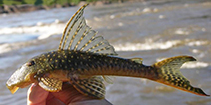
Pseudancistrus sidereus is diagnosed by a unique modification of the ventral plates on the caudal peduncle. In loricariids, the plates of the ventral row on the caudal peduncle are typically bent at an approximately 90° angle to follow the contour of the body. The bend is often the site of a slight keel formed from one or more rows of slightly longer odontodes. In P. sidereus, the keel is accentuated by having the dorsal laminae of the plates strongly concave. Although some loricariids may have the dorsal laminae slightly concave, it is much more pronounced in P. sidereus. Pseudancistrus sidereus can be separated from all other species of the Ancistrini by the presence of the keel mentioned above and by the presence of a single large white to yellow spot located at the center of the posterior lateral plates. The only species with a similar coloration are some Hypancistrus and some Panaque, both of which have far fewer than 25 teeth per jaw ramus (vs. much more than 25 teeth), some other species of Pseudancistrus which have hypertrophied odontodes along the snout in males and females (vs. no hypertrophied snout odontodes), and have the dorsal fin reaching at least the preadipose
plate when depressed (vs. about two plates anterior to preadipose plate); and some Hemiancistrus and Peckoltia which generally have the spots much more diffuse (vs. borders of spots distinct) and have the dorsal fin reaching at least the preadipose plate when
depressed (vs. about two plates anterior to preadipose plate) (Ref 53964).
Body shape (shape guide): elongated.
Facultative air-breathing in the genus (Ref. 126274)
Levenscyclus en paargedrag
Maturiteit | Voortplanting | Paaien | Eieren | Fecunditeit | Larven
Armbruster, J.W., 2004. Pseudancistrus sidereus, a new species from southern Venezuela (Siluriformes: Loricariidae) with a redescription of Pseudancistrus. Zootaxa 628:1-15. (Ref. 53269)
Status op de Rode Lijst van het IUCN (Ref. 130435: Version 2025-2 (Global))
Gevaar voor de mens
Harmless
Gebruik door de mens
Tools
Speciale rapporten
Download XML
Internetbronnen
Schattingen op basis van modellen
Fylogenetische diversiteitsindex (Ref.
82804): PD
50 = 0.5000 [Uniqueness, from 0.5 = low to 2.0 = high].
Bayesian length-weight: a=0.01549 (0.00726 - 0.03306), b=2.96 (2.79 - 3.13), in cm total length, based on LWR estimates for this (Sub)family-body shape (Ref.
93245).
Weerstandsvermogen (Ref.
120179): Gemiddeld, minimale populatieverdubbelingstijd 1,4-4,4 jaar (Preliminary K or Fecundity.).
Kwetsbaarheid van de visserij (Ref.
59153): Low vulnerability (11 of 100).
🛈