Classificazione / Nomi
Nomi Comuni | Sinonimi | Catalog of Fishes(Genere, Specie) | ITIS | CoL | WoRMS | Cloffa
>
Siluriformes (Catfishes) >
Loricariidae (Armored catfishes) > Hypostominae
Etymology: Pseudancistrus: Greek, pseudes = false + Greek, agkistron = hook (Ref. 45335).
Ambiente: milieu / zona climatica / distribuzione batimetrica / gamma di distribuzione
Ecologia
; acqua dolce demersale. Tropical
South America: Venezuela.
Dimensione / Peso / Età
Maturità: Lm ? range ? - ? cm
Max length : 17.6 cm SL maschio/sesso non determinato; (Ref. 53269)
Breve descrizione
Chiavi di identificazione | Morfologia | Morfometria
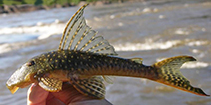
Pseudancistrus sidereus is diagnosed by a unique modification of the ventral plates on the caudal peduncle. In loricariids, the plates of the ventral row on the caudal peduncle are typically bent at an approximately 90° angle to follow the contour of the body. The bend is often the site of a slight keel formed from one or more rows of slightly longer odontodes. In P. sidereus, the keel is accentuated by having the dorsal laminae of the plates strongly concave. Although some loricariids may have the dorsal laminae slightly concave, it is much more pronounced in P. sidereus. Pseudancistrus sidereus can be separated from all other species of the Ancistrini by the presence of the keel mentioned above and by the presence of a single large white to yellow spot located at the center of the posterior lateral plates. The only species with a similar coloration are some Hypancistrus and some Panaque, both of which have far fewer than 25 teeth per jaw ramus (vs. much more than 25 teeth), some other species of Pseudancistrus which have hypertrophied odontodes along the snout in males and females (vs. no hypertrophied snout odontodes), and have the dorsal fin reaching at least the preadipose
plate when depressed (vs. about two plates anterior to preadipose plate); and some Hemiancistrus and Peckoltia which generally have the spots much more diffuse (vs. borders of spots distinct) and have the dorsal fin reaching at least the preadipose plate when
depressed (vs. about two plates anterior to preadipose plate) (Ref 53964).
Body shape (shape guide): elongated.
Facultative air-breathing in the genus (Ref. 126274)
Ciclo vitale e comportamento di accoppiamento
Maturità | Riproduzione | Deposizione | Uova | Fecondità | Larve
Armbruster, J.W., 2004. Pseudancistrus sidereus, a new species from southern Venezuela (Siluriformes: Loricariidae) with a redescription of Pseudancistrus. Zootaxa 628:1-15. (Ref. 53269)
Stato della Lista Rossa IUCN (Ref. 130435: Version 2025-2 (Global))
Minaccia per l'uomo
Harmless
Usi umani
Strumenti
Rapporti speciali
Scarica XML
Fonti Internet
Stime basate su modelli
Indice di diversità filogenetica (Fonte Biblio.
82804): PD
50 = 0.5000 [Uniqueness, from 0.5 = low to 2.0 = high].
Bayesian length-weight: a=0.01549 (0.00726 - 0.03306), b=2.96 (2.79 - 3.13), in cm total length, based on LWR estimates for this (Sub)family-body shape (Ref.
93245).
Resilienza (Fonte Biblio.
120179): Medio, tempo minimo di raddoppiamento della popolazione 1.4 - 4.4 anni (Preliminary K or Fecundity.).
Vulnerabilità della pesca (Ref.
59153): Low vulnerability (11 of 100).
🛈