>
Siluriformes (Catfishes) >
Loricariidae (Armored catfishes) > Hypostominae
Etymology: Pseudancistrus: Greek, pseudes = false + Greek, agkistron = hook (Ref. 45335).
Môi trường: môi trường / vùng khí hậu / Mức độ sâu / phạm vi phân phối
Sinh thái học
; nước ngọt gần đáy. Tropical
South America: Venezuela.
Bộ gần gũi / Khối lượng (Trọng lượng) / Tuổi
Chín muồi sinh dục: Lm ? range ? - ? cm
Max length : 17.6 cm SL con đực/không giới tính; (Ref. 53269)
Mô tả ngắn gọn
Khóa để định loại | Hình thái học | Sinh trắc học
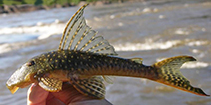
Pseudancistrus sidereus is diagnosed by a unique modification of the ventral plates on the caudal peduncle. In loricariids, the plates of the ventral row on the caudal peduncle are typically bent at an approximately 90° angle to follow the contour of the body. The bend is often the site of a slight keel formed from one or more rows of slightly longer odontodes. In P. sidereus, the keel is accentuated by having the dorsal laminae of the plates strongly concave. Although some loricariids may have the dorsal laminae slightly concave, it is much more pronounced in P. sidereus. Pseudancistrus sidereus can be separated from all other species of the Ancistrini by the presence of the keel mentioned above and by the presence of a single large white to yellow spot located at the center of the posterior lateral plates. The only species with a similar coloration are some Hypancistrus and some Panaque, both of which have far fewer than 25 teeth per jaw ramus (vs. much more than 25 teeth), some other species of Pseudancistrus which have hypertrophied odontodes along the snout in males and females (vs. no hypertrophied snout odontodes), and have the dorsal fin reaching at least the preadipose
plate when depressed (vs. about two plates anterior to preadipose plate); and some Hemiancistrus and Peckoltia which generally have the spots much more diffuse (vs. borders of spots distinct) and have the dorsal fin reaching at least the preadipose plate when
depressed (vs. about two plates anterior to preadipose plate) (Ref 53964).
Body shape (shape guide): elongated.
Facultative air-breathing in the genus (Ref. 126274)
Vòng đời và hành vi giao phối
Chín muồi sinh dục | Sự tái sinh sản | Đẻ trứng | Các trứng | Sự sinh sản | Ấu trùng
Armbruster, J.W., 2004. Pseudancistrus sidereus, a new species from southern Venezuela (Siluriformes: Loricariidae) with a redescription of Pseudancistrus. Zootaxa 628:1-15. (Ref. 53269)
Tình trạng Sách đỏ IUCN (Ref. 130435: Version 2025-2 (Global))
Mối đe dọa đối với con người
Harmless
Sử dụng của con người
Các công cụ
Báo cáo đặc biệt
Tải xuống XML
Các nguồn internet
Ước tính dựa trên mô hình
Chỉ số đa dạng phát sinh loài (Tài liệu tham khảo
82804): PD
50 = 0.5000 [Uniqueness, from 0.5 = low to 2.0 = high].
Bayesian length-weight: a=0.01549 (0.00726 - 0.03306), b=2.96 (2.79 - 3.13), in cm total length, based on LWR estimates for this (Sub)family-body shape (Ref.
93245).
Thích nghi nhanh (Tài liệu tham khảo
120179): Trung bình, thời gian nhân đôi của chủng quần tối thiểu là 1.4 - 4.4 năm (Preliminary K or Fecundity.).
Sự dễ bị tổn thương của nghề đánh cá (Ref.
59153): Low vulnerability (11 of 100).
🛈