>
Gobiiformes (Gobies) >
Gobiidae (Gobies) > Gobiinae
Etymology: Gobiodon: Latin, gobius = gudgeon + Greek, odous = teeth (Ref. 45335); irregularis: Named for its variable colouration, mainly its irregular red wavy lines on the head and upper body in juveniles and subadults.
Lingkungan: lingkungan / zona iklim / kisaran kedalaman / jangkauan distribusi
Ekologi
laut berasosiasi dengan karang. Tropical
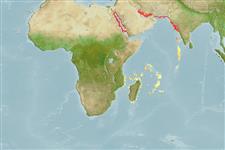
Western Indian Ocean: Gulf of Aqaba, Red Sea and Rodrigues.
Ukuran / Berat / umur
Kematangan: Lm ? range ? - ? cm
Max length : 3.2 cm SL jantan/; (Ref. 94082)
deskripsi pendek
Kunci identifiaksi (pengenalan) | Morfologi | Morfometrik
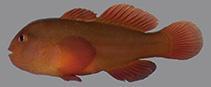
Duri punggung (Keseluruhan (total)) : 7; duri punggung lunak (Keseluruhan (total)) : 10 - 11; Duri dubur: 1; Sirip dubur lunak: 9 - 10. This species is distinguished by the following characters: D VI+I,10-11 (usually 11); A I,9-10 (usually 9); head and body are naked; body is relatively elongate (depth 35.1-39% SL) and compressed; head is slightly pointed in juveniles, becoming more rounded in adults; snout sometimes has a slight hump above upper lip; groove between isthmus and interopercle absent; slender caudal peduncle (depth 14.5-15.8% SL); caudal fin is relatively long (22.6-24.6% SL); colour of juveniles and subadults greenish or brownish green with up to 7 red bars with bluish interspaces on head and pectoral-fin base, 3 anteriormost bars also run across eye; nape and dorsal part of body with irregular red lines and small spots; lines and dots usually vanish in adults of more than 3 cm TL; body becomes uniformly brown or reddish brown, usually with remnants of the orbital and suborbital bars (Ref. 94082).
Body shape (shape guide): short and / or deep; Cross section: compressed.
Facultative air-breathing in the genus (Ref. 126274); This species exhibits a generalised habitat selection and occupies a great range of Acropora corals. It is found in deeper water regions, at lower reef slope and fore reef areas, and is most common in corals such as Acropora samoensis, A. valida and A. secale, but was also observed in Acropora eurystoma and A. pharaonis in the northern Red Sea (Ref. 94082).
Siklus hidup dan perilaku kawin
Kematangan | Reproduksi, perkembang biakan | Pemijahan | telur-telur | Fekunditas | Larva
Herler, J., S.V. Bogorodsky and T. Suzuki, 2013. Four new species of coral gobies (Teleostei: Gobiidae: Gobiodon), with comments on their relationships within the genus. Zootaxa 3709(4):301-329. (Ref. 94082)
Status IUCN Red List (Ref. 130435: Version 2025-2 (Global))
ancaman kepada manusia
Harmless
penggunaan manusia
Alat, peralatan
laporan khas
muat turun XML
Sumber internet
Estimasi berdasarkan model
Suhu yang disukai (Acuan
123201): 24.7 - 29.3, mean 27 °C (based on 140 cells).
Indeks keanekaragaman filogenetik (Acuan
82804): PD
50 = 0.5000 [Uniqueness, from 0.5 = low to 2.0 = high].
Bayesian length-weight: a=0.01995 (0.00906 - 0.04395), b=3.01 (2.83 - 3.19), in cm total length, based on all LWR estimates for this body shape (Ref.
93245).
Tingkat Trofik (Acuan
69278): 3.3 ±0.4 se; based on size and trophs of closest relatives
Daya lenting (Acuan
120179): Tinggi, Waktu penggandaan populasi minimum kurang dari 15 bulan (Preliminary K or Fecundity.).
Kerentanan Penangkapan Ikan (Ref.
59153): Low vulnerability (10 of 100).
🛈