>
Gobiiformes (Gobies) >
Gobiidae (Gobies) > Gobiinae
Etymology: Gobiodon: Latin, gobius = gudgeon + Greek, odous = teeth (Ref. 45335); irregularis: Named for its variable colouration, mainly its irregular red wavy lines on the head and upper body in juveniles and subadults.
Environnement : milieu / zone climatique / profondeur / gamme de distribution
Écologie
marin récifal. Tropical
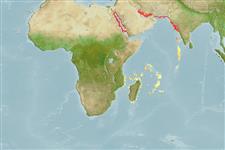
Western Indian Ocean: Gulf of Aqaba, Red Sea and Rodrigues.
Taille / Poids / Âge
Maturité: Lm ? range ? - ? cm
Max length : 3.2 cm SL mâle / non sexé; (Ref. 94082)
Description synthétique
Clés d'identification | Morphologie | Morphométrie
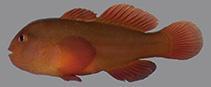
Épines dorsales (Total) : 7; Rayons mous dorsaux (Total) : 10 - 11; Épines anales: 1; Rayons mous anaux: 9 - 10. This species is distinguished by the following characters: D VI+I,10-11 (usually 11); A I,9-10 (usually 9); head and body are naked; body is relatively elongate (depth 35.1-39% SL) and compressed; head is slightly pointed in juveniles, becoming more rounded in adults; snout sometimes has a slight hump above upper lip; groove between isthmus and interopercle absent; slender caudal peduncle (depth 14.5-15.8% SL); caudal fin is relatively long (22.6-24.6% SL); colour of juveniles and subadults greenish or brownish green with up to 7 red bars with bluish interspaces on head and pectoral-fin base, 3 anteriormost bars also run across eye; nape and dorsal part of body with irregular red lines and small spots; lines and dots usually vanish in adults of more than 3 cm TL; body becomes uniformly brown or reddish brown, usually with remnants of the orbital and suborbital bars (Ref. 94082).
Body shape (shape guide): short and / or deep; Cross section: compressed.
Facultative air-breathing in the genus (Ref. 126274); This species exhibits a generalised habitat selection and occupies a great range of Acropora corals. It is found in deeper water regions, at lower reef slope and fore reef areas, and is most common in corals such as Acropora samoensis, A. valida and A. secale, but was also observed in Acropora eurystoma and A. pharaonis in the northern Red Sea (Ref. 94082).
Cycle de vie et comportement reproducteur
Maturité | Reproduction | Frai | Œufs | Fécondité | Larves
Herler, J., S.V. Bogorodsky and T. Suzuki, 2013. Four new species of coral gobies (Teleostei: Gobiidae: Gobiodon), with comments on their relationships within the genus. Zootaxa 3709(4):301-329. (Ref. 94082)
Statut dans la liste rouge de l'IUCN (Ref. 130435: Version 2025-2 (Global))
Menace pour l'homme
Harmless
Utilisations par l'homme
Outils
Articles particuliers
Télécharger en XML
Sources Internet
Estimations basées sur des modèles
Température préférée (Réf.
123201): 24.7 - 29.3, mean 27 °C (based on 140 cells).
Indice de diversité phylogénétique (Réf.
82804): PD
50 = 0.5000 [Uniqueness, from 0.5 = low to 2.0 = high].
Bayesian length-weight: a=0.01995 (0.00906 - 0.04395), b=3.01 (2.83 - 3.19), in cm total length, based on all LWR estimates for this body shape (Ref.
93245).
Niveau trophique (Réf.
69278): 3.3 ±0.4 se; based on size and trophs of closest relatives
Résilience (Réf.
120179): Haut, temps minimum de doublement de population inférieur à 15 mois (Preliminary K or Fecundity.).
Vulnérabilité de la pêche (Ref.
59153): Low vulnerability (10 of 100).
🛈