>
Gobiiformes (Gobies) >
Gobiidae (Gobies) > Gobiinae
Etymology: Gobiodon: Latin, gobius = gudgeon + Greek, odous = teeth (Ref. 45335); irregularis: Named for its variable colouration, mainly its irregular red wavy lines on the head and upper body in juveniles and subadults.
Milieu: milieu / Klimaatzone / Diepte / verspreidingsgebied
Ecologie
marien rifbewoner. Tropical
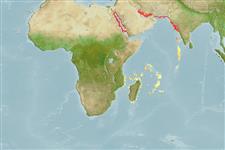
Western Indian Ocean: Gulf of Aqaba, Red Sea and Rodrigues.
Grootte / Gewicht / Leeftijd
Maturiteit: Lm ? range ? - ? cm
Max length : 3.2 cm SL mannelijk / geslacht onbekend; (Ref. 94082)
Korte beschrijving
Determinatiesleutels | Morfologie | Morfometrie
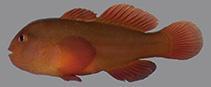
Dorsale stekels (totaal) : 7; Dorsale zachte stralen (totaal) : 10 - 11; Anale stekels: 1; Anale zachte stralen: 9 - 10. This species is distinguished by the following characters: D VI+I,10-11 (usually 11); A I,9-10 (usually 9); head and body are naked; body is relatively elongate (depth 35.1-39% SL) and compressed; head is slightly pointed in juveniles, becoming more rounded in adults; snout sometimes has a slight hump above upper lip; groove between isthmus and interopercle absent; slender caudal peduncle (depth 14.5-15.8% SL); caudal fin is relatively long (22.6-24.6% SL); colour of juveniles and subadults greenish or brownish green with up to 7 red bars with bluish interspaces on head and pectoral-fin base, 3 anteriormost bars also run across eye; nape and dorsal part of body with irregular red lines and small spots; lines and dots usually vanish in adults of more than 3 cm TL; body becomes uniformly brown or reddish brown, usually with remnants of the orbital and suborbital bars (Ref. 94082).
Body shape (shape guide): short and / or deep; Cross section: compressed.
Facultative air-breathing in the genus (Ref. 126274); This species exhibits a generalised habitat selection and occupies a great range of Acropora corals. It is found in deeper water regions, at lower reef slope and fore reef areas, and is most common in corals such as Acropora samoensis, A. valida and A. secale, but was also observed in Acropora eurystoma and A. pharaonis in the northern Red Sea (Ref. 94082).
Levenscyclus en paargedrag
Maturiteit | Voortplanting | Paaien | Eieren | Fecunditeit | Larven
Herler, J., S.V. Bogorodsky and T. Suzuki, 2013. Four new species of coral gobies (Teleostei: Gobiidae: Gobiodon), with comments on their relationships within the genus. Zootaxa 3709(4):301-329. (Ref. 94082)
Status op de Rode Lijst van het IUCN (Ref. 130435: Version 2025-2 (Global))
Gevaar voor de mens
Harmless
Gebruik door de mens
Tools
Speciale rapporten
Download XML
Internetbronnen
Schattingen op basis van modellen
Gewenste temperatuur (Ref.
123201): 24.7 - 29.3, mean 27 °C (based on 140 cells).
Fylogenetische diversiteitsindex (Ref.
82804): PD
50 = 0.5000 [Uniqueness, from 0.5 = low to 2.0 = high].
Bayesian length-weight: a=0.01995 (0.00906 - 0.04395), b=3.01 (2.83 - 3.19), in cm total length, based on all LWR estimates for this body shape (Ref.
93245).
Trofisch niveau (Ref.
69278): 3.3 ±0.4 se; based on size and trophs of closest relatives
Weerstandsvermogen (Ref.
120179): Hoog, minimale populatieverdubbelingstijd minder dan 15 maanden (Preliminary K or Fecundity.).
Kwetsbaarheid van de visserij (Ref.
59153): Low vulnerability (10 of 100).
🛈