klasifikasi / Nama
Nama-nama umum | Sinonim (persamaan) | Catalog of Fishes(Marga, Jenis) | ITIS | CoL | WoRMS | Cloffa
>
Siluriformes (Catfishes) >
Loricariidae (Armored catfishes) > Loricariinae
Etymology: Spatuloricaria: Latin, spatula, spathe = spatula, spatule + Latin, lorica, loricare = cuirass of corslet of leather; 1706 (Ref. 45335); tuira: Named in honor of a Brazilian Indian woman from Mebêngôkre/Kaiapó ethnicity who became a symbol of the resistance against construction of hydroelectric dams on the Rio Xingu.
Eponymy: Tuira was a Brazilian-Indian woman of Mebêngôkre/Kaiapó ethnicity who became a symbol (ca: 1989) of the resistance against construction of hydroelectric dams on the Rio Xingu, Brazil (where this catfish occurs). (Ref. 128868), visit book page.
Lingkungan: lingkungan / zona iklim / kisaran kedalaman / jangkauan distribusi
Ekologi
; air tawar dasar (demersal). Tropical
South America: Rio Xingu and the Rio Tapajós drainages in Brazil.
Ukuran / Berat / umur
Kematangan: Lm ? range ? - ? cm
Max length : 46.0 cm TL jantan/; (Ref. 126097); Berat maksimum terpublikasi: 130.00 g (Ref. 126097)
deskripsi pendek
Kunci identifiaksi (pengenalan) | Morfologi | Morfometrik
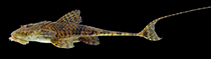
duri punggung lunak (Keseluruhan (total)) : 8; Sirip dubur lunak: 6. Spatuloricaria tuirais distinguished from all other congeners except Spatuloricaria nudiventris by its abdominal surface completely naked or rarely with few, very small plates (vs. abdominal region covered with plates) and by the absence of preanal plates (vs. presence of one to four preanal plates). It can be differentiated from S. nudiventris and S. fimbriata by having five transversal dark brown bands on the dorsal region (vs. four transversal dark brown dorsal bands in S. nudiventris and S. fimbriata) and by having dark-brown irregular stripes on the dorsal region of the head and predorsal area (vs. absence of such stripes in S. nudiventris and S. fimbriata). This species has the smallest males recorded among species of Spatuloricaria, with mature individuals ranging from 8.55 to 15.39 cm SL and seems to be the only one in the genus where mature males are smaller than mature females (the opposite is the case in other species of Spatuloricaria). However, additional materials of some of the other species are needed to further verify these observations (Ref. 96500).
Occurs on the bottom of medium to large rivers, in association with rocky or sandy substrates
in fast-flowing sectors (Ref. 96500).
Siklus hidup dan perilaku kawin
Kematangan | Reproduksi, perkembang biakan | Pemijahan | telur-telur | Fekunditas | Larva
Fichberg, I., O.T. Oyakawa and M. de Pinna, 2014. The end of an almost 70-year wait: a new species of Spatuloricaria (Siluriformes: Loricariidae) from the Rio Xingu and Rio Tapajós basins. Copeia 2014(2):317-324. (Ref. 96500)
Status IUCN Red List (Ref. 130435: Version 2025-2 (Global))
ancaman kepada manusia
Harmless
penggunaan manusia
Alat, peralatan
laporan khas
muat turun XML
Sumber internet
Estimasi berdasarkan model
Indeks keanekaragaman filogenetik (Acuan
82804): PD
50 = 0.5001 [Uniqueness, from 0.5 = low to 2.0 = high].
Bayesian length-weight: a=0.00240 (0.00131 - 0.00439), b=3.00 (2.84 - 3.16), in cm total length, based on LWR estimates for this species & (Sub)family-body (Ref.
93245).
Tingkat Trofik (Acuan
69278): 2.3 ±0.2 se; based on size and trophs of closest relatives
Daya lenting (Acuan
120179): Rendah, Waktu penggandaan populasi minimum 4.5 - 14 tahun (Preliminary K or Fecundity.).
Kerentanan Penangkapan Ikan (Ref.
59153): Moderate vulnerability (36 of 100).
🛈