Классификация / Имена
народные названия | синонимы | Catalog of Fishes(род, виды) | ITIS | CoL | WoRMS | Cloffa
>
Siluriformes (Catfishes) >
Loricariidae (Armored catfishes) > Loricariinae
Etymology: Spatuloricaria: Latin, spatula, spathe = spatula, spatule + Latin, lorica, loricare = cuirass of corslet of leather; 1706 (Ref. 45335); tuira: Named in honor of a Brazilian Indian woman from Mebêngôkre/Kaiapó ethnicity who became a symbol of the resistance against construction of hydroelectric dams on the Rio Xingu.
Eponymy: Tuira was a Brazilian-Indian woman of Mebêngôkre/Kaiapó ethnicity who became a symbol (ca: 1989) of the resistance against construction of hydroelectric dams on the Rio Xingu, Brazil (where this catfish occurs). (Ref. 128868), visit book page.
Окружающая среда: среда / климатическая зона / пределы глубины / диапазон распространения
экология
; пресноводный демерсальный. Tropical
South America: Rio Xingu and the Rio Tapajós drainages in Brazil.
Размер / Вес / Возраст
половая зрелость: Lm ? range ? - ? cm
Max length : 46.0 cm TL самец/пол неопределен; (Ref. 126097); наибольший вес (опубликованные данные): 130.00 g (Ref. 126097)
Краткое описание
определительные ключи | морфология | морфометрия
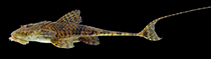
членистые (мягкие) лучи спинного плавника (общее число) : 8; членистые (мягкие) лучи анального плавника: 6. Spatuloricaria tuirais distinguished from all other congeners except Spatuloricaria nudiventris by its abdominal surface completely naked or rarely with few, very small plates (vs. abdominal region covered with plates) and by the absence of preanal plates (vs. presence of one to four preanal plates). It can be differentiated from S. nudiventris and S. fimbriata by having five transversal dark brown bands on the dorsal region (vs. four transversal dark brown dorsal bands in S. nudiventris and S. fimbriata) and by having dark-brown irregular stripes on the dorsal region of the head and predorsal area (vs. absence of such stripes in S. nudiventris and S. fimbriata). This species has the smallest males recorded among species of Spatuloricaria, with mature individuals ranging from 8.55 to 15.39 cm SL and seems to be the only one in the genus where mature males are smaller than mature females (the opposite is the case in other species of Spatuloricaria). However, additional materials of some of the other species are needed to further verify these observations (Ref. 96500).
Occurs on the bottom of medium to large rivers, in association with rocky or sandy substrates
in fast-flowing sectors (Ref. 96500).
Жизненный цикл и брачное поведение
половая зрелость | размножение | нерест | икра | Плодовитость | личинки
Fichberg, I., O.T. Oyakawa and M. de Pinna, 2014. The end of an almost 70-year wait: a new species of Spatuloricaria (Siluriformes: Loricariidae) from the Rio Xingu and Rio Tapajós basins. Copeia 2014(2):317-324. (Ref. 96500)
Статус Красного Списка МСОП (Ref. 130435: Version 2025-2 (Global))
Угроза для людей
Harmless
Использование человеком
дополнительная информация
инструменты
Специальные отчеты
Скачать в формате XML
ресурсы в Интернет
Оценки, основанные на моделях
Индекс филогенетического разнообразия (ссылка
82804): PD
50 = 0.5001 [Uniqueness, from 0.5 = low to 2.0 = high].
Bayesian length-weight: a=0.00240 (0.00131 - 0.00439), b=3.00 (2.84 - 3.16), in cm total length, based on LWR estimates for this species & (Sub)family-body (Ref.
93245).
Трофический уровень (ссылка
69278): 2.3 ±0.2 se; based on size and trophs of closest relatives
устойчивость к внешним воздействиям (ссылка
120179): низкий, минимальное время удвоения популяции 4.5-14 лет (Preliminary K or Fecundity.).
Уязвимость рыбной ловли (Ref.
59153): Moderate vulnerability (36 of 100).
🛈