>
Siluriformes (Catfishes) >
Loricariidae (Armored catfishes) > Loricariinae
Etymology: Spatuloricaria: Latin, spatula, spathe = spatula, spatule + Latin, lorica, loricare = cuirass of corslet of leather; 1706 (Ref. 45335); tuira: Named in honor of a Brazilian Indian woman from Mebêngôkre/Kaiapó ethnicity who became a symbol of the resistance against construction of hydroelectric dams on the Rio Xingu.
Eponymy: Tuira was a Brazilian-Indian woman of Mebêngôkre/Kaiapó ethnicity who became a symbol (ca: 1989) of the resistance against construction of hydroelectric dams on the Rio Xingu, Brazil (where this catfish occurs). (Ref. 128868), visit book page.
Môi trường: môi trường / vùng khí hậu / Mức độ sâu / phạm vi phân phối
Sinh thái học
; nước ngọt gần đáy. Tropical
South America: Rio Xingu and the Rio Tapajós drainages in Brazil.
Bộ gần gũi / Khối lượng (Trọng lượng) / Tuổi
Chín muồi sinh dục: Lm ? range ? - ? cm
Max length : 46.0 cm TL con đực/không giới tính; (Ref. 126097); Khối lượng cực đại được công bố: 130.00 g (Ref. 126097)
Mô tả ngắn gọn
Khóa để định loại | Hình thái học | Sinh trắc học
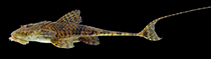
Các vây lưng mềm (tổng cộng) : 8; Tia mềm vây hậu môn: 6. Spatuloricaria tuirais distinguished from all other congeners except Spatuloricaria nudiventris by its abdominal surface completely naked or rarely with few, very small plates (vs. abdominal region covered with plates) and by the absence of preanal plates (vs. presence of one to four preanal plates). It can be differentiated from S. nudiventris and S. fimbriata by having five transversal dark brown bands on the dorsal region (vs. four transversal dark brown dorsal bands in S. nudiventris and S. fimbriata) and by having dark-brown irregular stripes on the dorsal region of the head and predorsal area (vs. absence of such stripes in S. nudiventris and S. fimbriata). This species has the smallest males recorded among species of Spatuloricaria, with mature individuals ranging from 8.55 to 15.39 cm SL and seems to be the only one in the genus where mature males are smaller than mature females (the opposite is the case in other species of Spatuloricaria). However, additional materials of some of the other species are needed to further verify these observations (Ref. 96500).
Occurs on the bottom of medium to large rivers, in association with rocky or sandy substrates
in fast-flowing sectors (Ref. 96500).
Vòng đời và hành vi giao phối
Chín muồi sinh dục | Sự tái sinh sản | Đẻ trứng | Các trứng | Sự sinh sản | Ấu trùng
Fichberg, I., O.T. Oyakawa and M. de Pinna, 2014. The end of an almost 70-year wait: a new species of Spatuloricaria (Siluriformes: Loricariidae) from the Rio Xingu and Rio Tapajós basins. Copeia 2014(2):317-324. (Ref. 96500)
Tình trạng Sách đỏ IUCN (Ref. 130435: Version 2025-2 (Global))
Mối đe dọa đối với con người
Harmless
Sử dụng của con người
Các công cụ
Báo cáo đặc biệt
Tải xuống XML
Các nguồn internet
Ước tính dựa trên mô hình
Chỉ số đa dạng phát sinh loài (Tài liệu tham khảo
82804): PD
50 = 0.5001 [Uniqueness, from 0.5 = low to 2.0 = high].
Bayesian length-weight: a=0.00240 (0.00131 - 0.00439), b=3.00 (2.84 - 3.16), in cm total length, based on LWR estimates for this species & (Sub)family-body (Ref.
93245).
Mức dinh dưỡng (Tài liệu tham khảo
69278): 2.3 ±0.2 se; based on size and trophs of closest relatives
Thích nghi nhanh (Tài liệu tham khảo
120179): thấp, thời gian nhân đôi của chủng quần tối thiểu là 4.5 - 14 năm (Preliminary K or Fecundity.).
Sự dễ bị tổn thương của nghề đánh cá (Ref.
59153): Moderate vulnerability (36 of 100).
🛈