>
Gobiiformes (Gobies) >
Gobiidae (Gobies) > Gobiinae
Etymology: Tomiyamichthys: occurring on sand-rubble bottoms in the vicinity of coral reefs; elliotensis: Named after its type locality, Lady Elliot Island on the Great Barrier Reef.
Lingkungan: lingkungan / zona iklim / kisaran kedalaman / jangkauan distribusi
Ekologi
laut berasosiasi dengan karang; kisaran kedalaman 15 - 24 m (Ref. 131301). Tropical; 20°C - 28°C (Ref. 131301)
Western Pacific: Australia.
Ukuran / Berat / umur
Kematangan: Lm ? range ? - ? cm
Max length : 3.9 cm SL jantan/; (Ref. 131301); 5.3 cm SL (female)
deskripsi pendek
Kunci identifiaksi (pengenalan) | Morfologi | Morfometrik
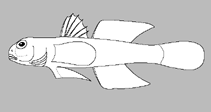
Duri punggung (Keseluruhan (total)) : 7; duri punggung lunak (Keseluruhan (total)) : 10; Duri dubur: 1; Sirip dubur lunak: 10; vertebrata, bertulang belakang: 26. This species is distinguished by the following characters: D VI-I,10, no elongated dorsal-fin spine, the longest 1.0-1.3 in HL; A I,10; pectoral-fin rays 17-18 (usually17); lateral scale series 78-84; entirely with cycloid scales, none on cheek, opercle, predorsal, and pectoral-fin base; gill opening extending to about the level of posterior edge of preopercle; caudal fin rounded, about equal to head length or 3.2-3.6 in SL; pattern of cephalic sensory-canal pores consisting of B’, C, D, E, F, G, H’, M’, N and O’ pores; gill rakers poorly developed, 2 + 4-6. Colouration: when alive, overall whitish with midlateral row of 4 large, ovate, brown spots, 5 or 6 diagonal yellow-orange bands on first dorsal fin, a brown stripe along middle of second dorsal fin; anal fin with several yellow-orange stripes; pelvic fins bluish with yellow fin rays (Ref. 31301).
Cross section: compressed.
Collected from relatively flat sandy bottoms exposed to periodic strong tidal currents in 15-24 m depth with temperature ranging from 20 to 28 °C across the year. Most individuals observed appeared to be solitary, while about 20% of burrows encountered had a pair of shrimpgobies guarding the entrance. Observations during peak tidal currents showed that nearly all shrimpgoby burrows were completely covered by shifting sands; only during slack tides would the alpheid shrimp reopen the burrow entrances. Many other species of shrimpgoby were commonly observed within 1 or 2 m of burrows of the new species, including Amblyeleotris diagonalis, A. novaecaledoniae, A. ogasawarensis, A. rubrimarginata, A. steinitzi, A. wheeleri, Ctenogobiops mitodes, C. pomastictus, and Stonogobiops xanthorhinica (Ref. 131301).
Siklus hidup dan perilaku kawin
Kematangan | Reproduksi, perkembang biakan | Pemijahan | telur-telur | Fekunditas | Larva
Allen, G.R., M.V. Erdmann and C.L. Dudgeon, 2023. Tomiyamichthys elliotensis, a new species of shrimpgoby (Teleostei: Gobiidae) from Lady Elliot Island, Queensland, Australia. J. Ocean Sci. Found. 40:57-69. (Ref. 131301)
Status IUCN Red List (Ref. 130435: Version 2025-2 (Global))
ancaman kepada manusia
Harmless
penggunaan manusia
Perikanan: tidak ada kepentingan
Alat, peralatan
laporan khas
muat turun XML
Sumber internet
Estimasi berdasarkan model
Indeks keanekaragaman filogenetik (Acuan
82804): PD
50 = 0.5000 [Uniqueness, from 0.5 = low to 2.0 = high].
Bayesian length-weight: a=0.00741 (0.00347 - 0.01582), b=3.09 (2.91 - 3.27), in cm total length, based on LWR estimates for this (Sub)family-body shape (Ref.
93245).
Tingkat Trofik (Acuan
69278): 3.2 ±0.3 se; based on size and trophs of closest relatives
Daya lenting (Acuan
120179): Tinggi, Waktu penggandaan populasi minimum kurang dari 15 bulan (Preliminary K or Fecundity.).
Kerentanan Penangkapan Ikan (Ref.
59153): Low vulnerability (10 of 100).
🛈