>
Gobiiformes (Gobies) >
Gobiidae (Gobies) > Gobiinae
Etymology: Tomiyamichthys: occurring on sand-rubble bottoms in the vicinity of coral reefs; elliotensis: Named after its type locality, Lady Elliot Island on the Great Barrier Reef.
Entorno: milieu / zona climática / rango de profundidad / gama de distribución
Ecología
marino asociado a arrecife; rango de profundidad 15 - 24 m (Ref. 131301). Tropical; 20°C - 28°C (Ref. 131301)
Western Pacific: Australia.
Tamaño / Peso / Edad
Madurez: Lm ? range ? - ? cm
Max length : 3.9 cm SL macho / no sexado; (Ref. 131301); 5.3 cm SL (female)
Descripción breve
Claves de identificación | Morfología | Morfometría
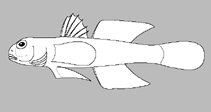
Espinas dorsales (total) : 7; Radios blandos dorsales (total) : 10; Espinas anales: 1; Radios blandos anales: 10; Vértebra: 26. This species is distinguished by the following characters: D VI-I,10, no elongated dorsal-fin spine, the longest 1.0-1.3 in HL; A I,10; pectoral-fin rays 17-18 (usually17); lateral scale series 78-84; entirely with cycloid scales, none on cheek, opercle, predorsal, and pectoral-fin base; gill opening extending to about the level of posterior edge of preopercle; caudal fin rounded, about equal to head length or 3.2-3.6 in SL; pattern of cephalic sensory-canal pores consisting of B’, C, D, E, F, G, H’, M’, N and O’ pores; gill rakers poorly developed, 2 + 4-6. Colouration: when alive, overall whitish with midlateral row of 4 large, ovate, brown spots, 5 or 6 diagonal yellow-orange bands on first dorsal fin, a brown stripe along middle of second dorsal fin; anal fin with several yellow-orange stripes; pelvic fins bluish with yellow fin rays (Ref. 31301).
Cross section: compressed.
Collected from relatively flat sandy bottoms exposed to periodic strong tidal currents in 15-24 m depth with temperature ranging from 20 to 28 °C across the year. Most individuals observed appeared to be solitary, while about 20% of burrows encountered had a pair of shrimpgobies guarding the entrance. Observations during peak tidal currents showed that nearly all shrimpgoby burrows were completely covered by shifting sands; only during slack tides would the alpheid shrimp reopen the burrow entrances. Many other species of shrimpgoby were commonly observed within 1 or 2 m of burrows of the new species, including Amblyeleotris diagonalis, A. novaecaledoniae, A. ogasawarensis, A. rubrimarginata, A. steinitzi, A. wheeleri, Ctenogobiops mitodes, C. pomastictus, and Stonogobiops xanthorhinica (Ref. 131301).
Ciclo vital y comportamiento de apareamiento
Madurez | Reproducción | Puesta | Huevos | Fecundidad | Larva
Allen, G.R., M.V. Erdmann and C.L. Dudgeon, 2023. Tomiyamichthys elliotensis, a new species of shrimpgoby (Teleostei: Gobiidae) from Lady Elliot Island, Queensland, Australia. J. Ocean Sci. Found. 40:57-69. (Ref. 131301)
Situación en la Lista Roja de la UICN (Ref. 130435: Version 2025-2 (Global))
Amenaza para el ser humano
Harmless
Usos humanos
Pesquerías: sin interés
Herramientas
Informes especiales
Descargar XML
Fuentes de Internet
Estimaciones basadas en modelos
Índice de diversidad filogenética (Referencia
82804): PD
50 = 0.5000 [Uniqueness, from 0.5 = low to 2.0 = high].
Bayesian length-weight: a=0.00741 (0.00347 - 0.01582), b=3.09 (2.91 - 3.27), in cm total length, based on LWR estimates for this (Sub)family-body shape (Ref.
93245).
Nivel trófico (Referencia
69278): 3.2 ±0.3 se; based on size and trophs of closest relatives
Resiliencia (Referencia
120179): Alto, población duplicada en un tiempo mínimo inferior a 15 meses (Preliminary K or Fecundity.).
Vulnerabilidad pesquera (Ref.
59153): Low vulnerability (10 of 100).
🛈