>
Gobiiformes (Gobies) >
Gobiidae (Gobies) > Gobiinae
Etymology: Tomiyamichthys: occurring on sand-rubble bottoms in the vicinity of coral reefs; elliotensis: Named after its type locality, Lady Elliot Island on the Great Barrier Reef.
Meio ambiente: milieu / Zona climática / intervalo de profundidade / faixa de distribuição
Ecologia
marinhas associadas(os) a recifes; intervalo de profundidade 15 - 24 m (Ref. 131301). Tropical; 20°C - 28°C (Ref. 131301)
Western Pacific: Australia.
Tamanho / Peso / Idade
Maturidade: Lm ? range ? - ? cm
Max length : 3.9 cm SL macho/indeterminado; (Ref. 131301); 5.3 cm SL (female)
Descrição suscinta
Chaves de identificação | Morfologia | Morfometria
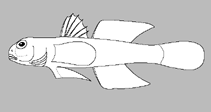
Espinhos dorsais (total) : 7; Raios dorsais (total) : 10; Espinhos anais: 1; Raios anais : 10; Vértebras: 26. This species is distinguished by the following characters: D VI-I,10, no elongated dorsal-fin spine, the longest 1.0-1.3 in HL; A I,10; pectoral-fin rays 17-18 (usually17); lateral scale series 78-84; entirely with cycloid scales, none on cheek, opercle, predorsal, and pectoral-fin base; gill opening extending to about the level of posterior edge of preopercle; caudal fin rounded, about equal to head length or 3.2-3.6 in SL; pattern of cephalic sensory-canal pores consisting of B’, C, D, E, F, G, H’, M’, N and O’ pores; gill rakers poorly developed, 2 + 4-6. Colouration: when alive, overall whitish with midlateral row of 4 large, ovate, brown spots, 5 or 6 diagonal yellow-orange bands on first dorsal fin, a brown stripe along middle of second dorsal fin; anal fin with several yellow-orange stripes; pelvic fins bluish with yellow fin rays (Ref. 31301).
Cross section: compressed.
Collected from relatively flat sandy bottoms exposed to periodic strong tidal currents in 15-24 m depth with temperature ranging from 20 to 28 °C across the year. Most individuals observed appeared to be solitary, while about 20% of burrows encountered had a pair of shrimpgobies guarding the entrance. Observations during peak tidal currents showed that nearly all shrimpgoby burrows were completely covered by shifting sands; only during slack tides would the alpheid shrimp reopen the burrow entrances. Many other species of shrimpgoby were commonly observed within 1 or 2 m of burrows of the new species, including Amblyeleotris diagonalis, A. novaecaledoniae, A. ogasawarensis, A. rubrimarginata, A. steinitzi, A. wheeleri, Ctenogobiops mitodes, C. pomastictus, and Stonogobiops xanthorhinica (Ref. 131301).
Ciclo de vida ou comportamento de acasalamento
Maturidade | Reprodução | Desova | Ovos | Fecundidade | Larvas
Allen, G.R., M.V. Erdmann and C.L. Dudgeon, 2023. Tomiyamichthys elliotensis, a new species of shrimpgoby (Teleostei: Gobiidae) from Lady Elliot Island, Queensland, Australia. J. Ocean Sci. Found. 40:57-69. (Ref. 131301)
Status na Lista Vermelha da UICN (Ref. 130435: Version 2025-2 (Global))
Ameaça para os humanos
Harmless
Uso pelos humanos
Pescarias: sem interesse
Ferramentas
Relatórios especiais
Baixar XML
Fontes da internet
Estimativas baseadas em modelos
Índice de diversidade filogenética (Ref.
82804): PD
50 = 0.5000 [Uniqueness, from 0.5 = low to 2.0 = high].
Bayesian length-weight: a=0.00741 (0.00347 - 0.01582), b=3.09 (2.91 - 3.27), in cm total length, based on LWR estimates for this (Sub)family-body shape (Ref.
93245).
Nível Trófico (Ref.
69278): 3.2 ±0.3 se; based on size and trophs of closest relatives
Resiliência (Ref.
120179): Elevada, tempo mínimo de duplicação da população menor que 15 meses (Preliminary K or Fecundity.).
Vulnerabilidade da pesca (Ref.
59153): Low vulnerability (10 of 100).
🛈