>
Carangiformes (Jacks) >
Carangidae (Jacks and pompanos) > Caranginae
Etymology: Caranx: French, carangue, the name of a Caribbean fish; 1836 (Ref. 45335).
More on author: Linnaeus.
Lingkungan: lingkungan / zona iklim / kisaran kedalaman / jangkauan distribusi
Ekologi
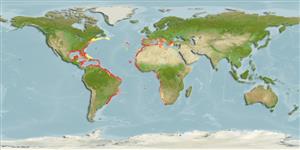
laut; payau pelagic-neritic; oceanodromus (Ref. 51243); kisaran kedalaman 1 - 350 m (Ref. 7097), usually 1 - 200 m (Ref. 55173). Subtropical
Atlantic Ocean, restricted to continental shelf areas. Mediterranean excluded.
Panjang pada saat jatuh tempo pertama / Ukuran / Berat / umur
Kematangan: Lm 66.0 range ? - ? cm
Max length : 124 cm TL jantan/; (Ref. 5217); common length : 75.0 cm TL jantan/; (Ref. 2683); Berat maksimum terpublikasi: 32.0 kg (Ref. 27584)
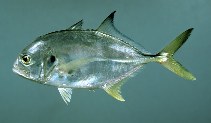
Duri punggung (Keseluruhan (total)) : 9; duri punggung lunak (Keseluruhan (total)) : 19 - 22; Duri dubur: 3; Sirip dubur lunak: 15 - 18. Diagnosis: Scutes on lateral line 23 (Ref. 57392) to 42 (Ref. 13442). No scales on chest (Ref. 13442), except a small mid-ventral patch in front of pelvic fins (Ref. 13442, 57392). Upper profile of head steep (Ref. 13442). Maxilla ending approximately below (Ref. 13442, 57392) or beyond (Ref. 57392) posterior edge of eye (in adult). Front of soft dorsal and anal fins elevated; olivaceous to bluish green dorsally, silvery to brassy on the sides; prominent black spot posteriorly on gill cover at level of eye, another at upper axil of pectoral fins, and often a third on lower pectoral rays; caudal yellowish (Ref. 13442).
Body shape (shape guide): fusiform / normal.
Generally in neritic waters over the continental shelf (Ref. 5217), from the coastline, where it is common on shallow flats, to offshore waters (Ref. 57392). Adults ascend rivers (Ref. 26938). Juveniles abundant in brackish estuaries with muddy bottoms, near sandy beaches and on seagrass beds (Ref. 5217), entering lagoons and lower courses of rivers (Ref. 57392). They form fast-moving schools, although larger fish may be solitary. They feed on smaller fish, shrimp, and other invertebrates (Ref. 5521). Often grunts or croaks are heard when caught. Eggs are pelagic (Ref. 4233).
Smith-Vaniz, W.F. and K.E. Carpenter, 2007. Review of the crevalle jacks, Caranx hippos complex (Teleostei: Carangidae), with a description of a new species from West Africa. Fish. Bull. 105(2):207-233. (Ref. 58464)
Status IUCN Red List (Ref. 130435: Version 2025-2 (Global))
ancaman kepada manusia
Reports of ciguatera poisoning (Ref. 4690)
penggunaan manusia
Perikanan: komersial; Ikan buruan: ya
Alat, peralatan
laporan khas
muat turun XML
Sumber internet
Estimasi berdasarkan model
Suhu yang disukai (Acuan
123201): 16.5 - 27.9, mean 24.8 °C (based on 2020 cells).
Indeks keanekaragaman filogenetik (Acuan
82804): PD
50 = 0.5000 [Uniqueness, from 0.5 = low to 2.0 = high].
Bayesian length-weight: a=0.01622 (0.01360 - 0.01934), b=2.96 (2.93 - 2.99), in cm total length, based on LWR estimates for this species (Ref.
93245).
Tingkat Trofik (Acuan
69278): 3.6 ±0.4 se; based on diet studies.
Generation time: 3.1 ( na - na) years. Estimated as median ln(3)/K based on 1
growth studies.
Daya lenting (Acuan
120179): sedang, Waktu penggandaan populasi minimum 1.4 - 4.4 tahun (K=0.35; assumed tm=2).
Prior r = 0.53, 95% CL = 0.35 - 0.80, Based on 5 data-limited stock assessments.
Kerentanan Penangkapan Ikan (Ref.
59153): Moderate vulnerability (41 of 100).
🛈
Kerentanan Iklim (Ref.
125649): High vulnerability (62 of 100).
🛈
Nutrisi (Ref.
124155): Calcium = 10.9 [4.1, 19.9] mg/100g; Iron = 0.33 [0.17, 0.68] mg/100g; Protein = 20.9 [18.7, 23.4] %; Omega3 = 0.218 [0.121, 0.391] g/100g; Selenium = 33.8 [14.2, 84.4] μg/100g; VitaminA = 16 [5, 56] μg/100g; Zinc = 0.357 [0.217, 0.574] mg/100g (wet weight); based on
nutrient studies.