>
Carangiformes (Jacks) >
Carangidae (Jacks and pompanos) > Caranginae
Etymology: Caranx: French, carangue, the name of a Caribbean fish; 1836 (Ref. 45335).
More on author: Linnaeus.
สิ่งแวดล้อม : สิ่งแวดล้อม / เขตภูมิอากาศ / ระดับความลึก / ระยะการกระจายสินค้า
นิเวศวิทยา
เกี่ยวกับทะเล,น้ำเค็ม; กร่อย pelagic-neritic; สัตว์น้ำที่อาศัยและอพยพภายในทะเลเท่านั้น (Ref. 51243); ระดับความลึก 1 - 350 m (Ref. 7097), usually 1 - 200 m (Ref. 55173). Subtropical
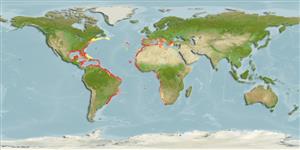
Atlantic Ocean, restricted to continental shelf areas. Mediterranean excluded.
ความยาวเมื่อครบกำหนดครั้งแรก / ขนาด / น้ำหนัก / อายุ
วัยเจริญพันธุ์: Lm 66.0 range ? - ? cm
Max length : 124 cm TL เพศผู้/กระเทย; (Ref. 5217); common length : 75.0 cm TL เพศผู้/กระเทย; (Ref. 2683); น้ำหนักสูงสุดที่มีการรายงาน: 32.0 kg (Ref. 27584)
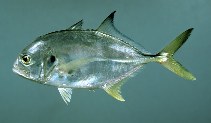
เงี่ยงครีบหลัง (รวม) : 9; ก้านครีบอ่อนที่หาง (รวม) : 19 - 22; เงี่ยงครีบก้น: 3; ก้านครีบอ่อนที่ก้น: 15 - 18. Diagnosis: Scutes on lateral line 23 (Ref. 57392) to 42 (Ref. 13442). No scales on chest (Ref. 13442), except a small mid-ventral patch in front of pelvic fins (Ref. 13442, 57392). Upper profile of head steep (Ref. 13442). Maxilla ending approximately below (Ref. 13442, 57392) or beyond (Ref. 57392) posterior edge of eye (in adult). Front of soft dorsal and anal fins elevated; olivaceous to bluish green dorsally, silvery to brassy on the sides; prominent black spot posteriorly on gill cover at level of eye, another at upper axil of pectoral fins, and often a third on lower pectoral rays; caudal yellowish (Ref. 13442).
Body shape (shape guide): fusiform / normal.
Generally in neritic waters over the continental shelf (Ref. 5217), from the coastline, where it is common on shallow flats, to offshore waters (Ref. 57392). Adults ascend rivers (Ref. 26938). Juveniles abundant in brackish estuaries with muddy bottoms, near sandy beaches and on seagrass beds (Ref. 5217), entering lagoons and lower courses of rivers (Ref. 57392). They form fast-moving schools, although larger fish may be solitary. They feed on smaller fish, shrimp, and other invertebrates (Ref. 5521). Often grunts or croaks are heard when caught. Eggs are pelagic (Ref. 4233).
Smith-Vaniz, W.F. and K.E. Carpenter, 2007. Review of the crevalle jacks, Caranx hippos complex (Teleostei: Carangidae), with a description of a new species from West Africa. Fish. Bull. 105(2):207-233. (Ref. 58464)
สถานะบัญชีแดงของ IUCN (Ref. 130435: Version 2025-2 (Global))
ภัยคุกคามต่อมนุษย์
Reports of ciguatera poisoning (Ref. 4690)
การใช้ของมนุษย์
การประมง: การค้า; การตกปลาเป็นกีฬา: ใช่
เครื่องมือ
รายงานพิเศษ
ดาวน์โหลด XML
แหล่งที่มาจากอินเตอร์เน็ต
การประมาณค่าตามแบบจำลอง
อุณหภูมิที่ต้องการ (อ้างอิง
123201): 16.5 - 27.9, mean 24.8 °C (based on 2020 cells).
ดัชนีความหลากหลายทางวิวัฒนาการ (อ้างอิง
82804): PD
50 = 0.5000 [Uniqueness, from 0.5 = low to 2.0 = high].
Bayesian length-weight: a=0.01622 (0.01360 - 0.01934), b=2.96 (2.93 - 2.99), in cm total length, based on LWR estimates for this species (Ref.
93245).
ระดับชั้นอาหาร (อ้างอิง
69278): 3.6 ±0.4 se; based on diet studies.
Generation time: 3.1 ( na - na) years. Estimated as median ln(3)/K based on 1
growth studies.
ความสามารถในการกลับคืนสู่ปกติ (อ้างอิง
120179): ขนาดกลาง, เวลาต่ำสุดที่จะทำให้ประชากรเพิ่มขึ้นเป็น 2 เท่าใช้เวลา 1.4 - 4.4 ปี (K=0.35; assumed tm=2).
Prior r = 0.53, 95% CL = 0.35 - 0.80, Based on 5 data-limited stock assessments.
ความเสี่ยงต่อการตกปลา (Ref.
59153): Moderate vulnerability (41 of 100).
🛈
ความเสี่ยงต่อสภาพภูมิอากาศ (Ref.
125649): High vulnerability (62 of 100).
🛈
สารอาหาร (Ref.
124155): Calcium = 10.9 [4.1, 19.9] mg/100g; Iron = 0.33 [0.17, 0.68] mg/100g; Protein = 20.9 [18.7, 23.4] %; Omega3 = 0.218 [0.121, 0.391] g/100g; Selenium = 33.8 [14.2, 84.4] μg/100g; VitaminA = 16 [5, 56] μg/100g; Zinc = 0.357 [0.217, 0.574] mg/100g (wet weight); based on
nutrient studies.