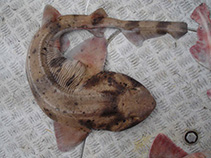
Cephaloscyllium isabella, Draughtsboard shark

You can sponsor this page

Cephaloscyllium isabella (Bonnaterre, 1788)

Draughtsboard shark
Carica il tuo foto e Video
Immagini | Google image
Image of Cephaloscyllium isabella (Draughtsboard shark)
Cephaloscyllium isabella
Immagine di Duffy, C.

Classificazione / Nomi Nomi Comuni | Sinonimi | Catalog of Fishes(Genere, Specie) | ITIS | CoL | WoRMS | Cloffa

Elasmobranchi (squali e razze) (sharks and rays) > Carcharhiniformes (Ground sharks) > Scyliorhinidae (Cat sharks) > Scyliorhininae
Etymology: Cephaloscyllium: cephalus, from kephale (Gr.), head, referring to its very broad and depressed head; skylion, Greek for dogfish or small shark (See ETYFish)isabella: Based on “d’Isabelle” of Broussonet (1780), who said the shark’s color inspired the name; probably derived from isabelline, a pale cream-brown parchment color, consistent with Broussonet’s description of “roux cendré” (i.e., fawn, tan or ashy brown) [often incorrectly spelled as an adjective, isabellum] (See ETYFish).
More on author: Bonnaterre.

Ambiente: milieu / zona climatica / distribuzione batimetrica / gamma di distribuzione Ecologia

marino associati a barriera corallina; distribuzione batimetrica 5 - 690 m (Ref. 26346). Subtropical; 33°S - 53°S, 165°E - 174°W

Distribuzione Territories | Aree FAO | Ecosistemi | Presenze | Mappa dei ritrovamenti | Introduzioni | Faunafri

Southwest Pacific: endemic to New Zealand.

Dimensione / Peso / Età

Maturità: Lm ?  range ? - ? cm
Max length : 100.0 cm TL maschio/sesso non determinato; (Ref. 26346)

Biologia     Glossario (es. epibenthic)

Found in crevices and caves of rocky reefs during the day, but may move to adjacent sandy areas at night (Ref. 12951). Reported from 18 m to 220 m depth (Ref. 12951). Feeds on fishes and invertebrates (Ref. 12951). Adults segregate by sex (Ref. 12951). Oviparous (Ref. 50449). 244 cm record from New Zealand possibly due to confusion with another species (Ref. 244). Can expand itself with air or water (Ref. 244).

Ciclo vitale e comportamento di accoppiamento Maturità | Riproduzione | Deposizione | Uova | Fecondità | Larve

Oviparous, paired eggs are laid. Embryos feed solely on yolk (Ref. 50449). Deposits two tendril eggcases at a time. Young hatch at 16 cm (Ref. 12951).

Riferimento principale Caricare le referenze | Bibliografia | Coordinatore : Compagno, Leonard J.V. | Collaboratori

Compagno, L.J.V., 1984. FAO Species Catalogue. Vol. 4. Sharks of the world. An annotated and illustrated catalogue of shark species known to date. Part 2 - Carcharhiniformes. FAO Fish. Synop. 125(4/2):251-655. Rome: FAO. (Ref. 244)

Stato della Lista Rossa IUCN (Ref. 130435: Version 2025-2 (Global))

  Least Concern (LC) ; Date assessed: 21 June 2017

CITES

Not Evaluated

CMS (Ref. 116361)

Not Evaluated

Minaccia per l'uomo

  Harmless


Usi umani

FAO - Publication: search | FishSource | Sea Around Us

Informazioni ulteriori

Ecologia trofica
Articoli alimentari (prede)
Alimentazione
Consumo di cibo
Razioni alimentari
Predatori
Ecologia
Ecologia
Dinamica della popolazione
Parametri di crescita
Età massima / dimensioni massime
Rapporto lunghezza-peso.
Lunghezza-lunghezza rel.
Lunghezza-frequenze
Conversione di massa
Reclutamento
Abbondanza
Ciclo di vita
Riproduzione
Maturità
Maturità/Gli occhielli sono relativi.
Fecondità
Deposizione
Aggregazioni riproduttive
Uova
Sviluppo delle uova
Larve
Dinamica popolazioni larvali
Distribuzione
Territories
Aree FAO
Ecosistemi
Presenze
Introduzioni
BRUVS - Video
Anatomia
Area branchiale
Cervello
Otolite
Fisiologia
Composizione corporea
Nutrienti
Consumo di ossigeno
Tipo di nuoto
Velocità di nuoto
Pigmenti visivi
Suono del pesce
Malattie e parassiti
Tossicità (LC50)
Genetica
Genome
Genetica
Eterozigosi
Ereditarietà
Diversità genetica
Legato all'uomo
Sistemi di acquacoltura
Profili di acquacoltura
Varietà
Casi di Ciguatera
Francobolli, monete, materiale vario.
Raggiungimento
Collaboratori
Tassonomia
Nomi Comuni
Sinonimi
Morfologia
Morfometria
Immagini
Bibliografia
Bibliografia

Strumenti

Rapporti speciali

Scarica XML

Fonti Internet

AFORO (otoliths) | Aquatic Commons | BHL | Cloffa | Websites from users | Check FishWatcher | CISTI | Catalog of Fishes: Genere, Specie | DiscoverLife | ECOTOX | FAO - Publication: search | Faunafri | Fishipedia | Fishtrace | GloBI | Google Books | Google Scholar | Google | IGFA World Record | Database Nazionali | OneZoom | Open Tree of Life | Otolith Atlas of Taiwan Fishes | PubMed | Reef Life Survey | Socotra Atlas | TreeBase | Tree of Life | Wikipedia: Go, ricerca | World Records Freshwater Fishing | Record zoologico

Stime basate su modelli

Temperatura preferita (Fonte Biblio. 123201): 7.9 - 14.9, mean 11.8 °C (based on 80 cells).
Indice di diversità filogenetica (Fonte Biblio. 82804):  PD50 = 0.5000   [Uniqueness, from 0.5 = low to 2.0 = high].
Bayesian length-weight: a=0.00269 (0.00140 - 0.00518), b=3.21 (3.04 - 3.38), in cm total length, based on LWR estimates for this (Sub)family-body shape (Ref. 93245).
Livello trofico (Fonte Biblio. 69278):  4.2   ±0.5 se; based on diet studies.
Resilienza (Fonte Biblio. 120179):  Basso, tempo minimo di raddoppiamento della popolazione 4.5 - 14 anni (Fec assumed to be <100).
Vulnerabilità della pesca (Ref. 59153):  High vulnerability (60 of 100). 🛈
Nutrienti (Ref. 124155):  Calcium = 5.97 [1.23, 31.31] mg/100g; Iron = 0.378 [0.099, 1.091] mg/100g; Protein = 19 [16, 22] %; Omega3 = 0.132 [0.054, 0.303] g/100g; Selenium = 19.6 [5.8, 59.3] μg/100g; VitaminA = 51.1 [17.4, 155.7] μg/100g; Zinc = 0.465 [0.217, 0.974] mg/100g (wet weight);