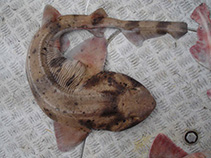
Elasmobranquios (tiburones y rayas) (sharks and rays) >
Carcharhiniformes (Ground sharks) >
Scyliorhinidae (Cat sharks) > Scyliorhininae
Etymology: Cephaloscyllium: cephalus, from kephale (Gr.), head, referring to its very broad and depressed head; skylion, Greek for dogfish or small shark (See ETYFish); isabella: Based on “d’Isabelle” of Broussonet (1780), who said the shark’s color inspired the name; probably derived from isabelline, a pale cream-brown parchment color, consistent with Broussonet’s description of “roux cendré” (i.e., fawn, tan or ashy brown) [often incorrectly spelled as an adjective, isabellum] (See ETYFish).
More on author: Bonnaterre.
Entorno: milieu / zona climática / rango de profundidad / gama de distribución
Ecología
marino asociado a arrecife; rango de profundidad 5 - 690 m (Ref. 26346). Subtropical; 33°S - 53°S, 165°E - 174°W
Southwest Pacific: endemic to New Zealand.
Tamaño / Peso / Edad
Madurez: Lm ? range ? - ? cm
Max length : 100.0 cm TL macho / no sexado; (Ref. 26346)
Found in crevices and caves of rocky reefs during the day, but may move to adjacent sandy areas at night (Ref. 12951). Reported from 18 m to 220 m depth (Ref. 12951). Feeds on fishes and invertebrates (Ref. 12951). Adults segregate by sex (Ref. 12951). Oviparous (Ref. 50449). 244 cm record from New Zealand possibly due to confusion with another species (Ref. 244). Can expand itself with air or water (Ref. 244).
Ciclo vital y comportamiento de apareamiento
Madurez | Reproducción | Puesta | Huevos | Fecundidad | Larva
Oviparous, paired eggs are laid. Embryos feed solely on yolk (Ref. 50449). Deposits two tendril eggcases at a time. Young hatch at 16 cm (Ref. 12951).
Compagno, L.J.V., 1984. FAO Species Catalogue. Vol. 4. Sharks of the world. An annotated and illustrated catalogue of shark species known to date. Part 2 - Carcharhiniformes. FAO Fish. Synop. 125(4/2):251-655. Rome: FAO. (Ref. 244)
Situación en la Lista Roja de la UICN (Ref. 130435: Version 2025-2 (Global))
Amenaza para el ser humano
Harmless
Usos humanos
Herramientas
Informes especiales
Descargar XML
Fuentes de Internet
Estimaciones basadas en modelos
Temperatura preferida (Referencia
123201): 7.9 - 14.9, mean 11.8 °C (based on 80 cells).
Índice de diversidad filogenética (Referencia
82804): PD
50 = 0.5000 [Uniqueness, from 0.5 = low to 2.0 = high].
Bayesian length-weight: a=0.00269 (0.00140 - 0.00518), b=3.21 (3.04 - 3.38), in cm total length, based on LWR estimates for this (Sub)family-body shape (Ref.
93245).
Nivel trófico (Referencia
69278): 4.2 ±0.5 se; based on diet studies.
Resiliencia (Referencia
120179): Bajo, población duplicada en un tiempo mínimo de 4.5-14 años (Fec assumed to be <100).
Vulnerabilidad pesquera (Ref.
59153): High vulnerability (60 of 100).
🛈
Nutrientes (Ref.
124155): Calcium = 5.97 [1.23, 31.31] mg/100g; Iron = 0.378 [0.099, 1.091] mg/100g; Protein = 19 [16, 22] %; Omega3 = 0.132 [0.054, 0.303] g/100g; Selenium = 19.6 [5.8, 59.3] μg/100g; VitaminA = 51.1 [17.4, 155.7] μg/100g; Zinc = 0.465 [0.217, 0.974] mg/100g (wet weight);