Milieu: milieu / Klimaatzone / Diepte / verspreidingsgebied
Ecologie
marien rifbewoner; standvastig (Ref. 52884); diepte 0 - 20 m (Ref. 93839). Tropical
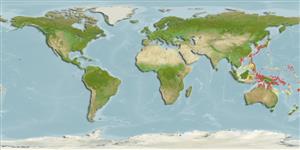
Western Pacific: southern Japan south to the Coral Sea.
Grootte / Gewicht / Leeftijd
Maturiteit: Lm ? range ? - ? cm
Max length : 10.0 cm TL mannelijk / geslacht onbekend; (Ref. 2334); common length : 8.0 cm SL mannelijk / geslacht onbekend; (Ref. 37816)
Korte beschrijving
Determinatiesleutels | Morfologie | Morfometrie
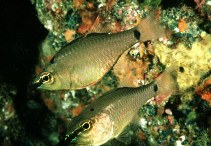
Dorsale stekels (totaal) : 8; Dorsale zachte stralen (totaal) : 9; Anale stekels: 2; Anale zachte stralen: 8. Characterized by having a black band from the snout to the eye; distinct spot on nape; black spot on caudal fin base; black blotch on the first dorsal fin distally; blackish bands along the bases of the second dorsal and anal fins (Ref. 93839).
Body shape (shape guide): short and / or deep; Cross section: compressed.
Occur in groups around coral bommies (Ref. 2334). In Japan, the breeding season is from June to September. Breeding pairs set up territory which is mostly defended by the female (Ref. 57690). Mouthbrooding is done by the male parents (Ref. 559 and 637) some of which resort to partial egg cannibalism probably to adjust the brood size to their buccal capacity (Ref. 57690). Nocturnal species, but courtship and spawning takes place during day (Ref. 7300, 37227, 38747).
Clutches of eggs from a single female are mouthbrooded by males (Ref. 57684). Distinct pairing (obligate monogamy) during courtship and spawning (Ref. 205, 52884). Multiple spawner with 10-19 days interval between matings (Ref. 38747). Females attack conspecifics during courtship (Ref. 57684). The operational sex ratio is male biased all throughout the breeding season primarily due to a higher mortality in females, thus sex-role reversal is not predicted for this species (Ref. 57684).
Randall, J.E., G.R. Allen and R.C. Steene, 1990. Fishes of the Great Barrier Reef and Coral Sea. University of Hawaii Press, Honolulu, Hawaii. 506 p. (Ref. 2334)
Status op de Rode Lijst van het IUCN (Ref. 130435: Version 2025-2 (Global))
Gevaar voor de mens
Harmless
Gebruik door de mens
Tools
Speciale rapporten
Download XML
Internetbronnen
Schattingen op basis van modellen
Gewenste temperatuur (Ref.
123201): 21.5 - 29.3, mean 28.4 °C (based on 1585 cells).
Fylogenetische diversiteitsindex (Ref.
82804): PD
50 = 0.5000 [Uniqueness, from 0.5 = low to 2.0 = high].
Bayesian length-weight: a=0.01318 (0.00580 - 0.02997), b=3.10 (2.92 - 3.28), in cm total length, based on LWR estimates for this Genus-body shape (Ref.
93245).
Trofisch niveau (Ref.
69278): 3.5 ±0.50 se; based on food items.
Weerstandsvermogen (Ref.
120179): Gemiddeld, minimale populatieverdubbelingstijd 1,4-4,4 jaar (Fec=3,315).
Kwetsbaarheid van de visserij (Ref.
59153): Low vulnerability (10 of 100).
🛈
Voedingsstoffen (Ref.
124155): Calcium = 148 [73, 243] mg/100g; Iron = 0.996 [0.568, 1.740] mg/100g; Protein = 18.6 [17.4, 19.8] %; Omega3 = 0.123 [0.068, 0.217] g/100g; Selenium = 29.4 [14.9, 58.0] μg/100g; VitaminA = 57.6 [16.8, 200.3] μg/100g; Zinc = 1.76 [1.14, 2.64] mg/100g (wet weight);