Окружающая среда: среда / климатическая зона / пределы глубины / диапазон распространения
экология
морской ассоциированный с рифами; немигрирующий (Ref. 52884); пределы глубины 0 - 20 m (Ref. 93839). Tropical
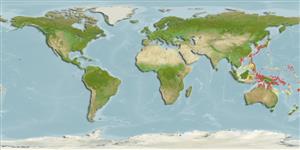
Western Pacific: southern Japan south to the Coral Sea.
Размер / Вес / Возраст
половая зрелость: Lm ? range ? - ? cm
Max length : 10.0 cm TL самец/пол неопределен; (Ref. 2334); common length : 8.0 cm SL самец/пол неопределен; (Ref. 37816)
Краткое описание
определительные ключи | морфология | морфометрия
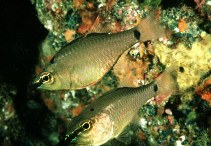
колючие лучи спинного плавника (общее число) : 8; членистые (мягкие) лучи спинного плавника (общее число) : 9; колючие лучи анального плавника: 2; членистые (мягкие) лучи анального плавника: 8. Characterized by having a black band from the snout to the eye; distinct spot on nape; black spot on caudal fin base; black blotch on the first dorsal fin distally; blackish bands along the bases of the second dorsal and anal fins (Ref. 93839).
Body shape (shape guide): short and / or deep; Cross section: compressed.
Occur in groups around coral bommies (Ref. 2334). In Japan, the breeding season is from June to September. Breeding pairs set up territory which is mostly defended by the female (Ref. 57690). Mouthbrooding is done by the male parents (Ref. 559 and 637) some of which resort to partial egg cannibalism probably to adjust the brood size to their buccal capacity (Ref. 57690). Nocturnal species, but courtship and spawning takes place during day (Ref. 7300, 37227, 38747).
Clutches of eggs from a single female are mouthbrooded by males (Ref. 57684). Distinct pairing (obligate monogamy) during courtship and spawning (Ref. 205, 52884). Multiple spawner with 10-19 days interval between matings (Ref. 38747). Females attack conspecifics during courtship (Ref. 57684). The operational sex ratio is male biased all throughout the breeding season primarily due to a higher mortality in females, thus sex-role reversal is not predicted for this species (Ref. 57684).
Randall, J.E., G.R. Allen and R.C. Steene, 1990. Fishes of the Great Barrier Reef and Coral Sea. University of Hawaii Press, Honolulu, Hawaii. 506 p. (Ref. 2334)
Статус Красного Списка МСОП (Ref. 130435: Version 2025-2 (Global))
Угроза для людей
Harmless
Использование человеком
дополнительная информация
инструменты
Специальные отчеты
Скачать в формате XML
ресурсы в Интернет
Оценки, основанные на моделях
Предпочтительная температура (ссылка
123201): 21.5 - 29.3, mean 28.4 °C (based on 1585 cells).
Индекс филогенетического разнообразия (ссылка
82804): PD
50 = 0.5000 [Uniqueness, from 0.5 = low to 2.0 = high].
Bayesian length-weight: a=0.01318 (0.00580 - 0.02997), b=3.10 (2.92 - 3.28), in cm total length, based on LWR estimates for this Genus-body shape (Ref.
93245).
Трофический уровень (ссылка
69278): 3.5 ±0.50 se; based on food items.
устойчивость к внешним воздействиям (ссылка
120179): средний (среднего размера), минимальное время удвоения популяции 1.4-4.4 года (Fec=3,315).
Уязвимость рыбной ловли (Ref.
59153): Low vulnerability (10 of 100).
🛈
Питательные вещества (Ref.
124155): Calcium = 148 [73, 243] mg/100g; Iron = 0.996 [0.568, 1.740] mg/100g; Protein = 18.6 [17.4, 19.8] %; Omega3 = 0.123 [0.068, 0.217] g/100g; Selenium = 29.4 [14.9, 58.0] μg/100g; VitaminA = 57.6 [16.8, 200.3] μg/100g; Zinc = 1.76 [1.14, 2.64] mg/100g (wet weight);