分類 / 名稱
俗名 | 同種異名 | Catalog of Fishes(屬, 種) | ITIS | CoL | WoRMS | Cloffa
Teleostei >
Perciformes/Percoidei (Perchs)
鱸形目 (Perchs) >
Percidae (Perches)
鱸科 (Perches) > Percinae
Etymology: Gymnocephalus: Greek, gymnos = naked + Greek, kephale = head (Ref. 45335); acerina: acerina is a noun.
More on author: Gmelin.
環境: 環境 / 氣候帶 / 深度上下限 / 配送範圍
生態學
; 淡水 居於水底的. 溫帶; 10°C - 24°C (Ref. 12468); 53°N - 44°N, 25°E - 27°E
Europe: basins of northern Black Sea and Sea of Azov in Dniester, South Bug, Dniepr, Don rivers and Kuban drainages; in Dniepr up to Belarus. Rare in most of its range.
歐洲: 第聶伯河,南方人蟲,聶伯河的流域, 北方 Donets 與頓河, 以及在黑海的北方支流中.(參考文獻 4537)
初熟時的長度 / 大小 / 重量 / 年齡
成熟度: Lm 14.0, range 12 - 16 cm
Max length : 21.0 cm SL 雄魚/尚未辨別雌雄; (Ref. 59043)
簡短描述
檢索表 | 型態特徵 | 形態測量圖
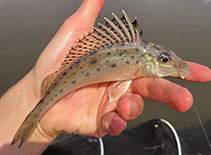
背棘 (總數) : 17 - 19. Distinguished uniquely from its congeners by having roundish dark spots on body, mostly in 3 rows, first below dorsal base, and 50-55 + 4-5 scales along lateral line. Can be further separated from other species of the genus by having 17-19 dorsal spines (Ref. 59043).
Body shape (shape guide): fusiform / normal.
Found in flowing waters and lakes with clear water. Also inhabits rapids during summer. Occurs over sand and gravel bottom but prefers hard compact sand. Usually crepuscular but feeds also during daytime. Preys predominantly on benthic invertebrates (crustaceans, insect larvae, molluscs), rarely on fish. Forms small schools. In September, starts forming large schools and moves to deeper places and remains inactive until ice melts. Does not undertake long distance migrations. Spawns in small schools river stretches with heavy current and sand or gravel bottom (Ref.59043).
生命週期和交配行為
成熟度 | 繁殖 | 產卵場 | 卵 | 孕卵數 | 仔魚
"Female lays slightly sticky eggs in several portions: first at 6-8°C, second at 12-14°C. Eggs hatch in 6-8 days at 14-16°C. Newly hatched larvae first lie on bottom; at 9 days (when pectorals are developed), they actively move to middle water layers and drift downstream. At 12 days (6.5mm) they start active feeding on small invertebrates in shallow shoreline habitats" (Ref. 59043).歐洲: 第聶伯河,南方人蟲,聶伯河的流域, 北方 Donets 與頓河, 以及在黑海的北方支流中.(參考文獻 4537)
Kottelat, M. and J. Freyhof, 2007. Handbook of European freshwater fishes. Publications Kottelat, Cornol and Freyhof, Berlin. 646 pp. (Ref. 59043)
IUCN 瀕危狀態 (Ref. 130435: Version 2025-2 (Global))
無危 (LC) ; Date assessed: 10 January 2023
人類使用
漁業: 沒有興趣
工具
特別的報告
下載 XML
網路資源
基於模型的估計
系統發育多樣性指數 (參考文獻
82804): PD
50 = 0.5312 [Uniqueness, from 0.5 = low to 2.0 = high].
Bayesian length-weight: a=0.01047 (0.00469 - 0.02338), b=3.05 (2.87 - 3.23), in cm total length, based on LWR estimates for this (Sub)family-body shape (Ref.
93245).
營養階層 (參考文獻
69278): 3.6 ±0.53 se; based on food items.
回復力 (參考文獻
120179): 中等的, 族群倍增時間最少 1.4 - 4.4年 (Preliminary K or Fecundity.).
釣魚的脆弱性 (Ref.
59153): Low vulnerability (16 of 100).
🛈