>
Perciformes/Percoidei (Perchs) >
Percidae (Perches) > Percinae
Etymology: Gymnocephalus: Greek, gymnos = naked + Greek, kephale = head (Ref. 45335); acerina: acerina is a noun.
More on author: Gmelin.
Entorno: milieu / zona climática / rango de profundidad / gama de distribución
Ecología
; agua dulce demersal. Temperate; 10°C - 24°C (Ref. 12468); 53°N - 44°N, 25°E - 27°E
Europe: basins of northern Black Sea and Sea of Azov in Dniester, South Bug, Dniepr, Don rivers and Kuban drainages; in Dniepr up to Belarus. Rare in most of its range.
Longitud en la primera madurez / Tamaño / Peso / Edad
Madurez: Lm 14.0, range 12 - 16 cm
Max length : 21.0 cm SL macho / no sexado; (Ref. 59043)
Descripción breve
Claves de identificación | Morfología | Morfometría
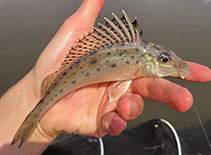
Espinas dorsales (total) : 17 - 19. Distinguished uniquely from its congeners by having roundish dark spots on body, mostly in 3 rows, first below dorsal base, and 50-55 + 4-5 scales along lateral line. Can be further separated from other species of the genus by having 17-19 dorsal spines (Ref. 59043).
Body shape (shape guide): fusiform / normal.
Found in flowing waters and lakes with clear water. Also inhabits rapids during summer. Occurs over sand and gravel bottom but prefers hard compact sand. Usually crepuscular but feeds also during daytime. Preys predominantly on benthic invertebrates (crustaceans, insect larvae, molluscs), rarely on fish. Forms small schools. In September, starts forming large schools and moves to deeper places and remains inactive until ice melts. Does not undertake long distance migrations. Spawns in small schools river stretches with heavy current and sand or gravel bottom (Ref.59043).
Ciclo vital y comportamiento de apareamiento
Madurez | Reproducción | Puesta | Huevos | Fecundidad | Larva
"Female lays slightly sticky eggs in several portions: first at 6-8°C, second at 12-14°C. Eggs hatch in 6-8 days at 14-16°C. Newly hatched larvae first lie on bottom; at 9 days (when pectorals are developed), they actively move to middle water layers and drift downstream. At 12 days (6.5mm) they start active feeding on small invertebrates in shallow shoreline habitats" (Ref. 59043).
Kottelat, M. and J. Freyhof, 2007. Handbook of European freshwater fishes. Publications Kottelat, Cornol and Freyhof, Berlin. 646 pp. (Ref. 59043)
Situación en la Lista Roja de la UICN (Ref. 130435: Version 2025-2 (Global))
Amenaza para el ser humano
Harmless
Usos humanos
Pesquerías: sin interés
Herramientas
Informes especiales
Descargar XML
Fuentes de Internet
Estimaciones basadas en modelos
Índice de diversidad filogenética (Referencia
82804): PD
50 = 0.5312 [Uniqueness, from 0.5 = low to 2.0 = high].
Bayesian length-weight: a=0.01047 (0.00469 - 0.02338), b=3.05 (2.87 - 3.23), in cm total length, based on LWR estimates for this (Sub)family-body shape (Ref.
93245).
Nivel trófico (Referencia
69278): 3.6 ±0.53 se; based on food items.
Resiliencia (Referencia
120179): Medio, población duplicada en un tiempo mínimo de 1.4-4.4 años (Preliminary K or Fecundity.).
Vulnerabilidad pesquera (Ref.
59153): Low vulnerability (16 of 100).
🛈