>
Perciformes/Percoidei (Perchs) >
Percidae (Perches) > Percinae
Etymology: Gymnocephalus: Greek, gymnos = naked + Greek, kephale = head (Ref. 45335); acerina: acerina is a noun.
More on author: Gmelin.
Môi trường: môi trường / vùng khí hậu / Mức độ sâu / phạm vi phân phối
Sinh thái học
; nước ngọt gần đáy. Temperate; 10°C - 24°C (Ref. 12468); 53°N - 44°N, 25°E - 27°E
Europe: basins of northern Black Sea and Sea of Azov in Dniester, South Bug, Dniepr, Don rivers and Kuban drainages; in Dniepr up to Belarus. Rare in most of its range.
Chiều dài lúc trưởng thành đầu tiên / Bộ gần gũi / Khối lượng (Trọng lượng) / Tuổi
Chín muồi sinh dục: Lm 14.0, range 12 - 16 cm
Max length : 21.0 cm SL con đực/không giới tính; (Ref. 59043)
Mô tả ngắn gọn
Khóa để định loại | Hình thái học | Sinh trắc học
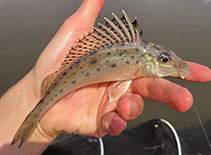
Các tia vây lưng cứng (tổng cộng) : 17 - 19. Distinguished uniquely from its congeners by having roundish dark spots on body, mostly in 3 rows, first below dorsal base, and 50-55 + 4-5 scales along lateral line. Can be further separated from other species of the genus by having 17-19 dorsal spines (Ref. 59043).
Body shape (shape guide): fusiform / normal.
Found in flowing waters and lakes with clear water. Also inhabits rapids during summer. Occurs over sand and gravel bottom but prefers hard compact sand. Usually crepuscular but feeds also during daytime. Preys predominantly on benthic invertebrates (crustaceans, insect larvae, molluscs), rarely on fish. Forms small schools. In September, starts forming large schools and moves to deeper places and remains inactive until ice melts. Does not undertake long distance migrations. Spawns in small schools river stretches with heavy current and sand or gravel bottom (Ref.59043).
Vòng đời và hành vi giao phối
Chín muồi sinh dục | Sự tái sinh sản | Đẻ trứng | Các trứng | Sự sinh sản | Ấu trùng
"Female lays slightly sticky eggs in several portions: first at 6-8°C, second at 12-14°C. Eggs hatch in 6-8 days at 14-16°C. Newly hatched larvae first lie on bottom; at 9 days (when pectorals are developed), they actively move to middle water layers and drift downstream. At 12 days (6.5mm) they start active feeding on small invertebrates in shallow shoreline habitats" (Ref. 59043).
Kottelat, M. and J. Freyhof, 2007. Handbook of European freshwater fishes. Publications Kottelat, Cornol and Freyhof, Berlin. 646 pp. (Ref. 59043)
Tình trạng Sách đỏ IUCN (Ref. 130435: Version 2025-2 (Global))
Mối đe dọa đối với con người
Harmless
Sử dụng của con người
Các nghề cá: không ích lợi (thú vị)
Các công cụ
Báo cáo đặc biệt
Tải xuống XML
Các nguồn internet
Ước tính dựa trên mô hình
Chỉ số đa dạng phát sinh loài (Tài liệu tham khảo
82804): PD
50 = 0.5312 [Uniqueness, from 0.5 = low to 2.0 = high].
Bayesian length-weight: a=0.01047 (0.00469 - 0.02338), b=3.05 (2.87 - 3.23), in cm total length, based on LWR estimates for this (Sub)family-body shape (Ref.
93245).
Mức dinh dưỡng (Tài liệu tham khảo
69278): 3.6 ±0.53 se; based on food items.
Thích nghi nhanh (Tài liệu tham khảo
120179): Trung bình, thời gian nhân đôi của chủng quần tối thiểu là 1.4 - 4.4 năm (Preliminary K or Fecundity.).
Sự dễ bị tổn thương của nghề đánh cá (Ref.
59153): Low vulnerability (16 of 100).
🛈