>
Clupeiformes (Herrings) >
Engraulidae (Anchovies) > Engraulinae
Etymology: Encrasicholina: Greek, egkrasicholos, -os, -on = mixed with spleen.
More on author: Rüppell.
Taxonomic Remarks
Encrasicholina pseudoheteroloba (Hardenberg 1933) is a valid species (Ref. 128293).
Miljö: miljö / Klimatzon / djupintervall / distributionsområde
Ekologi
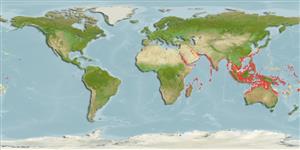
marina; brackvatten revassocierade; havsvandrande (Ref. 51243); djupintervall 20 - 50 m (Ref. 28016). Tropical; 32°N - 26°S, 30°E - 170°W (Ref. 189)
Indo-Pacific: Red Sea and East Africa to northern Madagascar and the Bay of Bengal; southern Japan and northern coast of Australia to the Solomon Islands, New Caledonia, Fiji, Tonga, and Samoa.
Längd vid första mognad / Storlek / Vikt / Ålder
Könsmognad: Lm 6.2, range 5 - 6.7 cm
Max length : 12.0 cm SL hane/ej könsbestämd; (Ref. 48635); common length : 7.5 cm NG hane/ej könsbestämd; (Ref. 27550); rapporterad maxålder: 1.70 år (Ref. 2178)
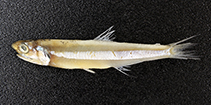
Taggstrålar i ryggfenan (totalt) : 0; Taggstrålar i analfenan: 0; Mjukstrålar i analfenan: 14 - 16. Belly rounded with 4 to 6 sharp needle-like pre-pelvic scutes. Maxilla tip pointed, projecting beyond second supra-maxilla and reaching to sub-operculum. Isthmus short, preceded by a small bony plate on urohyal between branchial membranes. Unbranched dorsal and anal fin rays only. Anal fin short. In life, a distinct blue upper edge to its lateral stripe and a dull silver or grey band on flank, the back beige.
Body shape (shape guide): elongated; Cross section: circular.
A schooling species found inshore, but also inhabits deep bays under oceanic influence. Rarely enter mangrove waters (Ref. 43081). Probably feed mainly on planktonic crustaceans (e.g., copepods, Ref. 8591). Eggs are oval, without a knob at one end. Eggs occur intermittently in the lower reaches of mangrove waters (Ref. 43081). Utilized mostly for bait, but also for human consumption as dried fish or fermented sauce (Ref. 9987).
Hata, H. and H. Motomura, 2016. Validity of Encrasicholina pseudoheteroloba (Hardenberg 1933) and redescription of Encrasicholina heteroloba (Rüppell 1837), a senior synonym of Encrasicholina devisi (Whitley 1940) (Clupeiformes: Engraulidae). Ichthyological Research 64(1):18-28. (Ref. 128293)
Status på IUCN:s rödlista (Ref. 130435: Version 2025-2 (Global))
Hot mot människor
Harmless
Mänskliga användningsområden
Fiskeri: mindre kommeriell; bete: usually
Verktyg
Särskilda rapporter
Ladda ner XML
Internet-källor
Uppskattningar baserade på modeller
Önskad temperatur (Ref.
123201): 24.2 - 28.8, mean 27.9 °C (based on 375 cells).
Index för fylogenetisk mångfald (Ref.
82804): PD
50 = 0.5005 [Uniqueness, from 0.5 = low to 2.0 = high].
Bayesian length-weight: a=0.00562 (0.00482 - 0.00656), b=3.15 (3.11 - 3.19), in cm total length, based on LWR estimates for this species (Ref.
93245).
Trofisk nivå (Ref.
69278): 3.3 ±0.1 se; based on diet studies.
Resiliens (Ref.
120179): Hög, lägsta populationsfördubblingstid mindre än 15 månader (K=0.80-4.09; tm=0.36-0.98).
Prior r = 0.37, 95% CL = 0.25 - 0.56, Based on 1 data-limited stock assessment.
Sårbarhet i fisket (Ref.
59153): Low vulnerability (10 of 100).
🛈
Näringsämnen (Ref.
124155): Calcium = 192 [48, 627] mg/100g; Iron = 1.52 [0.53, 3.89] mg/100g; Protein = 19.5 [16.9, 21.6] %; Omega3 = 0.205 [0.082, 0.508] g/100g; Selenium = 66.7 [20.9, 229.2] μg/100g; VitaminA = 26.9 [5.5, 148.6] μg/100g; Zinc = 1.7 [0.9, 4.1] mg/100g (wet weight);