>
Clupeiformes (Herrings) >
Engraulidae (Anchovies) > Engraulinae
Etymology: Encrasicholina: Greek, egkrasicholos, -os, -on = mixed with spleen.
More on author: Rüppell.
Taxonomic Remarks
Encrasicholina pseudoheteroloba (Hardenberg 1933) is a valid species (Ref. 128293).
Môi trường: môi trường / vùng khí hậu / Mức độ sâu / phạm vi phân phối
Sinh thái học
biển; thuộc về nước lợ cùng sống ở rạn san hô; Ở đại duơng, biển (Ref. 51243); mức độ sâu 20 - 50 m (Ref. 28016). Tropical; 32°N - 26°S, 30°E - 170°W (Ref. 189)
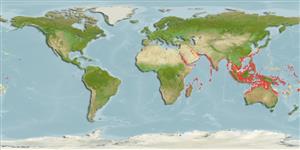
Indo-Pacific: Red Sea and East Africa to northern Madagascar and the Bay of Bengal; southern Japan and northern coast of Australia to the Solomon Islands, New Caledonia, Fiji, Tonga, and Samoa.
Chiều dài lúc trưởng thành đầu tiên / Bộ gần gũi / Khối lượng (Trọng lượng) / Tuổi
Chín muồi sinh dục: Lm 6.2, range 5 - 6.7 cm
Max length : 12.0 cm SL con đực/không giới tính; (Ref. 48635); common length : 7.5 cm NG con đực/không giới tính; (Ref. 27550); Tuổi cực đại được báo cáo: 1.70 các năm (Ref. 2178)
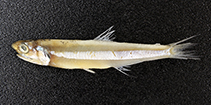
Các tia vây lưng cứng (tổng cộng) : 0; Tia cứng vây hậu môn: 0; Tia mềm vây hậu môn: 14 - 16. Belly rounded with 4 to 6 sharp needle-like pre-pelvic scutes. Maxilla tip pointed, projecting beyond second supra-maxilla and reaching to sub-operculum. Isthmus short, preceded by a small bony plate on urohyal between branchial membranes. Unbranched dorsal and anal fin rays only. Anal fin short. In life, a distinct blue upper edge to its lateral stripe and a dull silver or grey band on flank, the back beige.
Body shape (shape guide): elongated; Cross section: circular.
A schooling species found inshore, but also inhabits deep bays under oceanic influence. Rarely enter mangrove waters (Ref. 43081). Probably feed mainly on planktonic crustaceans (e.g., copepods, Ref. 8591). Eggs are oval, without a knob at one end. Eggs occur intermittently in the lower reaches of mangrove waters (Ref. 43081). Utilized mostly for bait, but also for human consumption as dried fish or fermented sauce (Ref. 9987).
Hata, H. and H. Motomura, 2016. Validity of Encrasicholina pseudoheteroloba (Hardenberg 1933) and redescription of Encrasicholina heteroloba (Rüppell 1837), a senior synonym of Encrasicholina devisi (Whitley 1940) (Clupeiformes: Engraulidae). Ichthyological Research 64(1):18-28. (Ref. 128293)
Tình trạng Sách đỏ IUCN (Ref. 130435: Version 2025-2 (Global))
Mối đe dọa đối với con người
Harmless
Sử dụng của con người
Các nghề cá: buôn bán nhỏ; mồi: usually
Các công cụ
Báo cáo đặc biệt
Tải xuống XML
Các nguồn internet
Ước tính dựa trên mô hình
Nhiệt độ ưa thích (Tài liệu tham khảo
123201): 24.2 - 28.8, mean 27.9 °C (based on 375 cells).
Chỉ số đa dạng phát sinh loài (Tài liệu tham khảo
82804): PD
50 = 0.5005 [Uniqueness, from 0.5 = low to 2.0 = high].
Bayesian length-weight: a=0.00562 (0.00482 - 0.00656), b=3.15 (3.11 - 3.19), in cm total length, based on LWR estimates for this species (Ref.
93245).
Mức dinh dưỡng (Tài liệu tham khảo
69278): 3.3 ±0.1 se; based on diet studies.
Thích nghi nhanh (Tài liệu tham khảo
120179): Chiêù cao, thời gian nhân đôi của chủng quần tối thiểu là dưới 15 tháng (K=0.80-4.09; tm=0.36-0.98).
Prior r = 0.37, 95% CL = 0.25 - 0.56, Based on 1 data-limited stock assessment.
Sự dễ bị tổn thương của nghề đánh cá (Ref.
59153): Low vulnerability (10 of 100).
🛈
Chất dinh dưỡng (Ref.
124155): Calcium = 192 [48, 627] mg/100g; Iron = 1.52 [0.53, 3.89] mg/100g; Protein = 19.5 [16.9, 21.6] %; Omega3 = 0.205 [0.082, 0.508] g/100g; Selenium = 66.7 [20.9, 229.2] μg/100g; VitaminA = 26.9 [5.5, 148.6] μg/100g; Zinc = 1.7 [0.9, 4.1] mg/100g (wet weight);