分類 / 名稱
俗名 | 同種異名 | Catalog of Fishes(屬, 種) | ITIS | CoL | WoRMS | Cloffa
Teleostei >
Siluriformes (Catfishes)
鯰形目 (Catfishes) >
Loricariidae (Armored catfishes)
甲鯰科 (Armored catfishes) > Hypoptopomatinae
Etymology: Curculionichthys: Derived from the from the Latin 'curculionem' (elongated snout) and from the Greek 'ichthys' (fishes), in reference to the relatively elongated snouts of the fish species included in this genus; sabaji: Named for Dr. Mark Henry Sabaj Pérez, Collection Manager of Ichthyology, Academy of Natural Sciences of Philadelphia, in recognition of his dedication and contributions to study of Neotropical
fishes especially from Rio Xingu basin (iXingu Project).
Eponymy: Dr Mark Henry Sabaj Pérez (d: 1969) is an ichthyologist and collection manager of fishes at the Academy of Natural Sciences of Philadelphia (2000–present). [...] (Ref. 128868), visit book page.
環境: 環境 / 氣候帶 / 深度上下限 / 配送範圍
生態學
; 淡水 居於水底的.
分布
領土 | FAO區域 | 生態系 | 發現紀錄 | 分布圖 | 簡介 | Faunafri
South America: Rio Xingu basin in Brazil.
大小 / 重量 / 年齡
成熟度: Lm ? range ? - ? cm
Max length : 2.4 cm SL 雄魚/尚未辨別雌雄; (Ref. 113800)
簡短描述
檢索表 | 型態特徵 | 形態測量圖
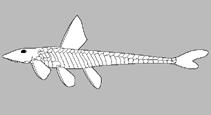
背的軟條 (總數) : 9; 臀鰭軟條: 5; 脊椎骨: 28. Curculionichthys sabaji is distinguished from all congeners by possessing several dark-brown spots distributed on the body (vs. a variety of pigment patterns, but none of which includes dark-brown spots). It also differs from all con¬geners, except C. coxipone and C. paresi by having the cleithrum with an area free of odontodes (vs. cleithrum completely covered with odontodes). Other characters useful to further diagnosed this species from other congengers include the following: some papillae of the lower lip arranged in a medial longitudinal series extending posterior to dentaries through the middle portion of the lower lip (vs. lower lip with all papillae randomly distributed in from C. piracanjuba, C. sagarana, and C. oliveirai); anterior profile of the head pointed (vs. rounded in C. coxipone and C. oliveirai); odontodes forming longitudinally aligned rows on head and trunk (vs. odontodes not forming longitudinally aligned rows on head and trunk in C. piracanjuba); small, inconspicuous odontodes forming rows on the head and trunk (vs. large, conspicuous odontodes forming rows on the head and the trunk in C. insperatus); caudal fin hyaline, with one dark strip extending from caudal peduncle base to the median caudal fin rays, and dark chromatophores irregular distributed almost forming two bands (vs. caudal fin hyaline, with dark blotch limited to caudal peduncle base in C. insperatus and C. sagarana); absence of one unpaired platelet on the dorsal portion of caudal peduncle (vs. one unpaired platelet on the dorsal portion of the caudal peduncle in C. sagarana); 6?9 lateral abdomen plates (vs. 4?5 lateral abdomen plates in C. oliveirai); absence of contrasting dark geometric spots on the anterodorsal region of body (vs. pres¬ence of geometric spots in C. paresi); not having hypertrophied odontodes on the snout tip (vs. hypertrophied odontodes on the snout tip in C. piracanjuba). In addition, Curculionichthys sabaji can be distinguished by having a shorter dorsal fin spine (18.5?22.7% of SL, vs. 25.2?27.0% of SL in C. paresi; 23.2?26.9% of SL in C. insperatus); a shorter pectoral-fin spine (18.9?23.4% of SL, vs. 27.0?30.1% of SL in C. paresi); a deeper caudal peduncle (7.0?10.0% of SL, vs. 10.8?12.5% of SL in C. oliveirai; 10.2?11.3% of SL in C. paresi); a deeper head (40.9?49.1% of HL, vs. 51.6?59.2% of HL in C. oliveirai); a longer head (34.3?38.6% of SL, vs. 27.9?32.2% of SL in C. piracanjuba; 28.8?33.3% of SL in C. luteofrenatus); a shorter snout (45.5?56.9% of HL, vs. 67.7?72.7% of HL in C. piracanjuba; 67.0?75.3% of HL in C. luteofrenatus) and a shorter interorbital width (30.3?35.7% of HL, vs. 36.7?40.9% of HL in C. piracanjuba; 67.0?75.3% of HL in C. luteofrenatus) (Ref. 113800).
Body shape (shape guide): elongated.
生命週期和交配行為
成熟度 | 繁殖 | 產卵場 | 卵 | 孕卵數 | 仔魚
Roxo, F.F., G.S.C. Silva, L.E. Ochoa and C. Oliveira, 2015. Description of a new genus and three new species of Otothyrinae (Siluriformes, Loricariidae). Zookeys 534:103-134. (Ref. 113800)
IUCN 瀕危狀態 (Ref. 130435: Version 2025-2 (Global))
人類使用
漁業: 沒有興趣
工具
特別的報告
下載 XML
網路資源
基於模型的估計
系統發育多樣性指數 (參考文獻
82804): PD
50 = 0.5001 [Uniqueness, from 0.5 = low to 2.0 = high].
Bayesian length-weight: a=0.00977 (0.00434 - 0.02202), b=3.06 (2.87 - 3.25), in cm total length, based on LWR estimates for this (Sub)family-body shape (Ref.
93245).
營養階層 (參考文獻
69278): 2.7 ±0.1 se; based on size and trophs of closest relatives
回復力 (參考文獻
120179): 高度, 族群倍增時間少於 15個月 (Preliminary K or Fecundity.).
釣魚的脆弱性 (Ref.
59153): Low vulnerability (10 of 100).
🛈