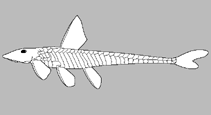
Классификация / Имена
народные названия | синонимы | Catalog of Fishes(род, виды) | ITIS | CoL | WoRMS | Cloffa
>
Siluriformes (Catfishes) >
Loricariidae (Armored catfishes) > Hypoptopomatinae
Etymology: Curculionichthys: Derived from the from the Latin 'curculionem' (elongated snout) and from the Greek 'ichthys' (fishes), in reference to the relatively elongated snouts of the fish species included in this genus; sabaji: Named for Dr. Mark Henry Sabaj Pérez, Collection Manager of Ichthyology, Academy of Natural Sciences of Philadelphia, in recognition of his dedication and contributions to study of Neotropical
fishes especially from Rio Xingu basin (iXingu Project).
Eponymy: Dr Mark Henry Sabaj Pérez (d: 1969) is an ichthyologist and collection manager of fishes at the Academy of Natural Sciences of Philadelphia (2000–present). [...] (Ref. 128868), visit book page.
Окружающая среда: среда / климатическая зона / пределы глубины / диапазон распространения
экология
; пресноводный демерсальный. Tropical
South America: Rio Xingu basin in Brazil.
Размер / Вес / Возраст
половая зрелость: Lm ? range ? - ? cm
Max length : 2.4 cm SL самец/пол неопределен; (Ref. 113800)
Краткое описание
определительные ключи | морфология | морфометрия
членистые (мягкие) лучи спинного плавника (общее число) : 9; членистые (мягкие) лучи анального плавника: 5; позвонки: 28. Curculionichthys sabaji is distinguished from all congeners by possessing several dark-brown spots distributed on the body (vs. a variety of pigment patterns, but none of which includes dark-brown spots). It also differs from all con¬geners, except C. coxipone and C. paresi by having the cleithrum with an area free of odontodes (vs. cleithrum completely covered with odontodes). Other characters useful to further diagnosed this species from other congengers include the following: some papillae of the lower lip arranged in a medial longitudinal series extending posterior to dentaries through the middle portion of the lower lip (vs. lower lip with all papillae randomly distributed in from C. piracanjuba, C. sagarana, and C. oliveirai); anterior profile of the head pointed (vs. rounded in C. coxipone and C. oliveirai); odontodes forming longitudinally aligned rows on head and trunk (vs. odontodes not forming longitudinally aligned rows on head and trunk in C. piracanjuba); small, inconspicuous odontodes forming rows on the head and trunk (vs. large, conspicuous odontodes forming rows on the head and the trunk in C. insperatus); caudal fin hyaline, with one dark strip extending from caudal peduncle base to the median caudal fin rays, and dark chromatophores irregular distributed almost forming two bands (vs. caudal fin hyaline, with dark blotch limited to caudal peduncle base in C. insperatus and C. sagarana); absence of one unpaired platelet on the dorsal portion of caudal peduncle (vs. one unpaired platelet on the dorsal portion of the caudal peduncle in C. sagarana); 6?9 lateral abdomen plates (vs. 4?5 lateral abdomen plates in C. oliveirai); absence of contrasting dark geometric spots on the anterodorsal region of body (vs. pres¬ence of geometric spots in C. paresi); not having hypertrophied odontodes on the snout tip (vs. hypertrophied odontodes on the snout tip in C. piracanjuba). In addition, Curculionichthys sabaji can be distinguished by having a shorter dorsal fin spine (18.5?22.7% of SL, vs. 25.2?27.0% of SL in C. paresi; 23.2?26.9% of SL in C. insperatus); a shorter pectoral-fin spine (18.9?23.4% of SL, vs. 27.0?30.1% of SL in C. paresi); a deeper caudal peduncle (7.0?10.0% of SL, vs. 10.8?12.5% of SL in C. oliveirai; 10.2?11.3% of SL in C. paresi); a deeper head (40.9?49.1% of HL, vs. 51.6?59.2% of HL in C. oliveirai); a longer head (34.3?38.6% of SL, vs. 27.9?32.2% of SL in C. piracanjuba; 28.8?33.3% of SL in C. luteofrenatus); a shorter snout (45.5?56.9% of HL, vs. 67.7?72.7% of HL in C. piracanjuba; 67.0?75.3% of HL in C. luteofrenatus) and a shorter interorbital width (30.3?35.7% of HL, vs. 36.7?40.9% of HL in C. piracanjuba; 67.0?75.3% of HL in C. luteofrenatus) (Ref. 113800).
Body shape (shape guide): elongated.
Жизненный цикл и брачное поведение
половая зрелость | размножение | нерест | икра | Плодовитость | личинки
Roxo, F.F., G.S.C. Silva, L.E. Ochoa and C. Oliveira, 2015. Description of a new genus and three new species of Otothyrinae (Siluriformes, Loricariidae). Zookeys 534:103-134. (Ref. 113800)
Статус Красного Списка МСОП (Ref. 130435: Version 2025-2 (Global))
Угроза для людей
Harmless
Использование человеком
рыболовство: интереса не представляет
дополнительная информация
инструменты
Специальные отчеты
Скачать в формате XML
ресурсы в Интернет
Оценки, основанные на моделях
Индекс филогенетического разнообразия (ссылка
82804): PD
50 = 0.5001 [Uniqueness, from 0.5 = low to 2.0 = high].
Bayesian length-weight: a=0.00977 (0.00434 - 0.02202), b=3.06 (2.87 - 3.25), in cm total length, based on LWR estimates for this (Sub)family-body shape (Ref.
93245).
Трофический уровень (ссылка
69278): 2.7 ±0.1 se; based on size and trophs of closest relatives
устойчивость к внешним воздействиям (ссылка
120179): высокий, минимальное время удвоения популяции до 15 месяцев (Preliminary K or Fecundity.).
Уязвимость рыбной ловли (Ref.
59153): Low vulnerability (10 of 100).
🛈