رده بندی / نامها
اسامي عام | مترادف | Catalog of Fishes(جنس, گونه ها) | ITIS | CoL | WoRMS | Cloffa
>
Siluriformes (Catfishes) >
Loricariidae (Armored catfishes) > Hypoptopomatinae
Etymology: Curculionichthys: Derived from the from the Latin 'curculionem' (elongated snout) and from the Greek 'ichthys' (fishes), in reference to the relatively elongated snouts of the fish species included in this genus; sabaji: Named for Dr. Mark Henry Sabaj Pérez, Collection Manager of Ichthyology, Academy of Natural Sciences of Philadelphia, in recognition of his dedication and contributions to study of Neotropical
fishes especially from Rio Xingu basin (iXingu Project).
Eponymy: Dr Mark Henry Sabaj Pérez (d: 1969) is an ichthyologist and collection manager of fishes at the Academy of Natural Sciences of Philadelphia (2000–present). [...] (Ref. 128868), visit book page.
محیط زیست: محیط زیست / منطقه آب و هوایی / تغييرات عمق / محدوده توزیع
بوم شناسي
; آب شيرين نزديك كف زي. Tropical
South America: Rio Xingu basin in Brazil.
اندازه / وزن / سن
بلوغ: Lm ? range ? - ? cm
Max length : 2.4 cm SL جنس نر / بدون خواص جنسي; (Ref. 113800)
توصيف مختصر
كليدهاي شناسايي | ريخت شناسي | ريخت ستجي بوسيله انداره گيري
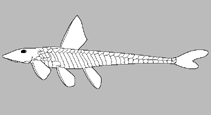
شعاع نرم باله پشتي (کل) : 9; شعاع نرم باله مخرجي: 5; مهره ها: 28. Curculionichthys sabaji is distinguished from all congeners by possessing several dark-brown spots distributed on the body (vs. a variety of pigment patterns, but none of which includes dark-brown spots). It also differs from all con¬geners, except C. coxipone and C. paresi by having the cleithrum with an area free of odontodes (vs. cleithrum completely covered with odontodes). Other characters useful to further diagnosed this species from other congengers include the following: some papillae of the lower lip arranged in a medial longitudinal series extending posterior to dentaries through the middle portion of the lower lip (vs. lower lip with all papillae randomly distributed in from C. piracanjuba, C. sagarana, and C. oliveirai); anterior profile of the head pointed (vs. rounded in C. coxipone and C. oliveirai); odontodes forming longitudinally aligned rows on head and trunk (vs. odontodes not forming longitudinally aligned rows on head and trunk in C. piracanjuba); small, inconspicuous odontodes forming rows on the head and trunk (vs. large, conspicuous odontodes forming rows on the head and the trunk in C. insperatus); caudal fin hyaline, with one dark strip extending from caudal peduncle base to the median caudal fin rays, and dark chromatophores irregular distributed almost forming two bands (vs. caudal fin hyaline, with dark blotch limited to caudal peduncle base in C. insperatus and C. sagarana); absence of one unpaired platelet on the dorsal portion of caudal peduncle (vs. one unpaired platelet on the dorsal portion of the caudal peduncle in C. sagarana); 6?9 lateral abdomen plates (vs. 4?5 lateral abdomen plates in C. oliveirai); absence of contrasting dark geometric spots on the anterodorsal region of body (vs. pres¬ence of geometric spots in C. paresi); not having hypertrophied odontodes on the snout tip (vs. hypertrophied odontodes on the snout tip in C. piracanjuba). In addition, Curculionichthys sabaji can be distinguished by having a shorter dorsal fin spine (18.5?22.7% of SL, vs. 25.2?27.0% of SL in C. paresi; 23.2?26.9% of SL in C. insperatus); a shorter pectoral-fin spine (18.9?23.4% of SL, vs. 27.0?30.1% of SL in C. paresi); a deeper caudal peduncle (7.0?10.0% of SL, vs. 10.8?12.5% of SL in C. oliveirai; 10.2?11.3% of SL in C. paresi); a deeper head (40.9?49.1% of HL, vs. 51.6?59.2% of HL in C. oliveirai); a longer head (34.3?38.6% of SL, vs. 27.9?32.2% of SL in C. piracanjuba; 28.8?33.3% of SL in C. luteofrenatus); a shorter snout (45.5?56.9% of HL, vs. 67.7?72.7% of HL in C. piracanjuba; 67.0?75.3% of HL in C. luteofrenatus) and a shorter interorbital width (30.3?35.7% of HL, vs. 36.7?40.9% of HL in C. piracanjuba; 67.0?75.3% of HL in C. luteofrenatus) (Ref. 113800).
Body shape (shape guide): elongated.
چرخه زندگی و رفتار جفتگیری
بلوغ | تولید مثل | تخم ریزی | تخم ها | باروری | توزاد ( لارو)
Roxo, F.F., G.S.C. Silva, L.E. Ochoa and C. Oliveira, 2015. Description of a new genus and three new species of Otothyrinae (Siluriformes, Loricariidae). Zookeys 534:103-134. (Ref. 113800)
وضعيت در فهرست قرمز IUCN (Ref. 130435: Version 2025-2 (Global))
خطر برای انسان ها
Harmless
استفاده انسانی
ماهي گيري – شيلات: از بی علاقه گی
ابزارها
گزارش های ويژه
بارگيری XML
منابع اينترنتي
تخمینها بر اساس مدلها
شاخص تنوع فیلوژنتیکی (مرجع
82804): PD
50 = 0.5001 [Uniqueness, from 0.5 = low to 2.0 = high].
Bayesian length-weight: a=0.00977 (0.00434 - 0.02202), b=3.06 (2.87 - 3.25), in cm total length, based on LWR estimates for this (Sub)family-body shape (Ref.
93245).
سطح تروفیک (مرجع
69278): 2.7 ±0.1 se; based on size and trophs of closest relatives
جهندگی (مرجع
120179): زياد, كمينه زمان لازم براي دو برابر شدن جمعيت ، كمتر از 15 ماه (Preliminary K or Fecundity.).
آسیبپذیری ماهیگیری (Ref.
59153): Low vulnerability (10 of 100).
🛈