Classificação / Nomes
Nomes comuns | Sinónimos | Catalog of Fishes(Género, Espécies) | ITIS | CoL | WoRMS | Cloffa
>
Siluriformes (Catfishes) >
Loricariidae (Armored catfishes) > Hypoptopomatinae
Etymology: Curculionichthys: Derived from the from the Latin 'curculionem' (elongated snout) and from the Greek 'ichthys' (fishes), in reference to the relatively elongated snouts of the fish species included in this genus; sabaji: Named for Dr. Mark Henry Sabaj Pérez, Collection Manager of Ichthyology, Academy of Natural Sciences of Philadelphia, in recognition of his dedication and contributions to study of Neotropical
fishes especially from Rio Xingu basin (iXingu Project).
Eponymy: Dr Mark Henry Sabaj Pérez (d: 1969) is an ichthyologist and collection manager of fishes at the Academy of Natural Sciences of Philadelphia (2000–present). [...] (Ref. 128868), visit book page.
Ambiente: milieu / zona climática / intervalo de profundidade / gama de distribuição
Ecologia
; Água doce demersal. Tropical
South America: Rio Xingu basin in Brazil.
Tamanho / Peso / Idade
Maturidade: Lm ? range ? - ? cm
Max length : 2.4 cm SL macho/indeterminado; (Ref. 113800)
Descrição breve
Chaves de identificação | Morfologia | Morfometria
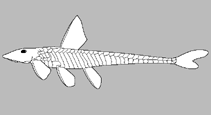
Raios dorsais moles (total) : 9; Raios anais moles: 5; Vértebras: 28. Curculionichthys sabaji is distinguished from all congeners by possessing several dark-brown spots distributed on the body (vs. a variety of pigment patterns, but none of which includes dark-brown spots). It also differs from all con¬geners, except C. coxipone and C. paresi by having the cleithrum with an area free of odontodes (vs. cleithrum completely covered with odontodes). Other characters useful to further diagnosed this species from other congengers include the following: some papillae of the lower lip arranged in a medial longitudinal series extending posterior to dentaries through the middle portion of the lower lip (vs. lower lip with all papillae randomly distributed in from C. piracanjuba, C. sagarana, and C. oliveirai); anterior profile of the head pointed (vs. rounded in C. coxipone and C. oliveirai); odontodes forming longitudinally aligned rows on head and trunk (vs. odontodes not forming longitudinally aligned rows on head and trunk in C. piracanjuba); small, inconspicuous odontodes forming rows on the head and trunk (vs. large, conspicuous odontodes forming rows on the head and the trunk in C. insperatus); caudal fin hyaline, with one dark strip extending from caudal peduncle base to the median caudal fin rays, and dark chromatophores irregular distributed almost forming two bands (vs. caudal fin hyaline, with dark blotch limited to caudal peduncle base in C. insperatus and C. sagarana); absence of one unpaired platelet on the dorsal portion of caudal peduncle (vs. one unpaired platelet on the dorsal portion of the caudal peduncle in C. sagarana); 6?9 lateral abdomen plates (vs. 4?5 lateral abdomen plates in C. oliveirai); absence of contrasting dark geometric spots on the anterodorsal region of body (vs. pres¬ence of geometric spots in C. paresi); not having hypertrophied odontodes on the snout tip (vs. hypertrophied odontodes on the snout tip in C. piracanjuba). In addition, Curculionichthys sabaji can be distinguished by having a shorter dorsal fin spine (18.5?22.7% of SL, vs. 25.2?27.0% of SL in C. paresi; 23.2?26.9% of SL in C. insperatus); a shorter pectoral-fin spine (18.9?23.4% of SL, vs. 27.0?30.1% of SL in C. paresi); a deeper caudal peduncle (7.0?10.0% of SL, vs. 10.8?12.5% of SL in C. oliveirai; 10.2?11.3% of SL in C. paresi); a deeper head (40.9?49.1% of HL, vs. 51.6?59.2% of HL in C. oliveirai); a longer head (34.3?38.6% of SL, vs. 27.9?32.2% of SL in C. piracanjuba; 28.8?33.3% of SL in C. luteofrenatus); a shorter snout (45.5?56.9% of HL, vs. 67.7?72.7% of HL in C. piracanjuba; 67.0?75.3% of HL in C. luteofrenatus) and a shorter interorbital width (30.3?35.7% of HL, vs. 36.7?40.9% of HL in C. piracanjuba; 67.0?75.3% of HL in C. luteofrenatus) (Ref. 113800).
Body shape (shape guide): elongated.
Ciclo de vida e comportamento de acasalamento
Maturidade | Reprodução | Desova | Ovos | Fecundidade | Larvas
Roxo, F.F., G.S.C. Silva, L.E. Ochoa and C. Oliveira, 2015. Description of a new genus and three new species of Otothyrinae (Siluriformes, Loricariidae). Zookeys 534:103-134. (Ref. 113800)
Categoria na Lista Vermelha da IUCN (Ref. 130435: Version 2025-2 (Global))
Ameaça para o homem
Harmless
Utilização humana
Pescarias: sem interesse
Ferramentas
Relatórios especiais
Descarregue XML
Fontes da internet
Estimativas baseadas em modelos
Índice de diversidade filogenética (Ref.
82804): PD
50 = 0.5001 [Uniqueness, from 0.5 = low to 2.0 = high].
Bayesian length-weight: a=0.00977 (0.00434 - 0.02202), b=3.06 (2.87 - 3.25), in cm total length, based on LWR estimates for this (Sub)family-body shape (Ref.
93245).
Nível Trófico (Ref.
69278): 2.7 ±0.1 se; based on size and trophs of closest relatives
Resiliência (Ref.
120179): Elevada, tempo mínimo de duplicação da população menor que 15 meses (Preliminary K or Fecundity.).
Vulnerabilidade da pesca (Ref.
59153): Low vulnerability (10 of 100).
🛈