Élasmobranches (requins et raies) (sharks and rays) >
Myliobatiformes (Stingrays) >
Dasyatidae (Stingrays) > Hypolophinae
Etymology: Pastinachus: Latin, pastinaca = a sting ray (Ref. 45335).
Taxonomic Remarks
This species which is similar to Pastinachus ater, an Indo-West Pacific species, is found only in Northwestern Indian Ocean. Erroneous information will be deleted.
Environnement : milieu / zone climatique / profondeur / gamme de distribution
Écologie
marin; eau douce; saumâtre récifal; amphidrome (Ref. 51243); profondeur 0 - 60 m (Ref. 6871). Tropical
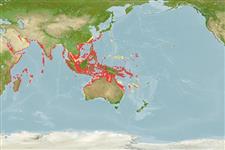
Northwestern Indian Ocean: Red Sea to Pakistan.
Longueur à la première maturité / Taille / Poids / Âge
Maturité: Lm 98.0, range 96 - 100 cm
Max length : 183 cm WD mâle / non sexé; (Ref. 37816); common length : 65.0 cm WD mâle / non sexé; (Ref. 27550)
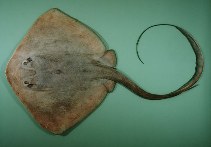
Épines dorsales (Total) : 0. A large, plain, dark stingray with an angular snout and pectoral disc; tail long and broad-based, less than twice body length, and with no upper caudal finfold but with high lower caudal finfold- 2 to 3 times depth of tail but not reaching tail tip; no large thorns; 1 or 2 long stings on tail, further behind tail base than in most stingrays; unique hexagonal, high-crowned teeth (Ref. 5578). Dark brown or black dorsally without conspicuous markings, white ventrally (Ref. 5578). Tail black (Ref. 3263).
Body shape (shape guide): other.
Found in lagoons, reef flats, and reef faces (Ref. 12951). Also in rivers far from the sea (Ref. 5578). Feeds on bony fishes, worms, shrimp, and crabs (Ref. 12951). Ovoviviparous (Ref. 50449). Adults are sometimes accompanied by remoras or members of the trevally family (Ref. 6871). Size at birth about 18 cm WD or larger (Ref. 6871). Flesh utilized as food and skin used for polishing wood (Ref. 4832). Possibly caught by sports anglers (Ref. 5578). Recently there is a targeted fishery on this species for its skin, which is used as 'shagreen' in fashion accessories, from wallets to fancy pens; as a result, the species is in danger of disappearance (IHT 26.11.2005, p.5). Maximum length about 300 cm TL (Ref. 30573).
Cycle de vie et comportement reproducteur
Maturité | Reproduction | Frai | Œufs | Fécondité | Larves
Exhibit ovoviparity (aplacental viviparity), with embryos feeding initially on yolk, then receiving additional nourishment from the mother by indirect absorption of uterine fluid enriched with mucus, fat or protein through specialised structures (Ref. 50449). Distinct pairing with embrace (Ref. 205). Size at birth ~ 18 cm WD (Ref.58048).
Last, P.R. and J.D. Stevens, 1994. Sharks and rays of Australia. CSIRO, Australia. 513 p. (Ref. 6871)
Statut dans la liste rouge de l'IUCN (Ref. 130435: Version 2025-2 (Global))
Menace pour l'homme
Venomous
Utilisations par l'homme
Pêcheries: intérêt commercial mineur; Aquarium: Commercial
Outils
Articles particuliers
Télécharger en XML
Sources Internet
Estimations basées sur des modèles
Température préférée (Réf.
123201): 24.7 - 29.1, mean 28.2 °C (based on 1694 cells).
Indice de diversité phylogénétique (Réf.
82804): PD
50 = 0.5312 [Uniqueness, from 0.5 = low to 2.0 = high].
Bayesian length-weight: a=0.01000 (0.00244 - 0.04107), b=3.04 (2.81 - 3.27), in cm total length, based on all LWR estimates for this body shape (Ref.
93245).
Niveau trophique (Réf.
69278): 3.7 ±0.60 se; based on food items.
Résilience (Réf.
120179): Très faible, temps minimum de doublement de population supérieur à 14 ans (Assuming Fec<10).
Vulnérabilité de la pêche (Ref.
59153): Very high vulnerability (90 of 100).
🛈
Nutriments (Ref.
124155): Calcium = 8.51 [1.64, 34.97] mg/100g; Iron = 0.364 [0.085, 0.964] mg/100g; Protein = 22.9 [19.9, 26.0] %; Omega3 = 0.102 [0.029, 0.298] g/100g; Selenium = 31.4 [9.0, 84.2] μg/100g; VitaminA = 33 [12, 99] μg/100g; Zinc = 0.851 [0.416, 1.706] mg/100g (wet weight);