>
Clupeiformes (Herrings) >
Dorosomatidae (Gizzard shads and sardinellas)
Etymology: Herklotsichthys: After Janus Adrian Herklots, Australian ichthyologist, 1820-1872.
Eponymy: Dr Geoffrey Alton Craig Herklots (1902–1986) was a British biologist, botanist and ornithologist at the University of Hong Kong (1928–1941). [...] (Ref. 128868), visit book page.
More on author: Rüppell.
البيئة: الوسط / المنطقة المناخية / نطاق العمق / نطاق التوزيع
البيئة
بحري; المياه العذبة; مياه مخلوطة مرتبطة بالشعاب; نطاق العمق 0 - 13 m (Ref. 82332). Tropical; 39°N - 33°S, 29°E - 166°W (Ref. 188)
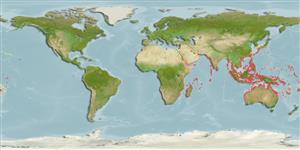
Indo-Pacific: widespread in Indian Ocean and western Pacific, including entire eastern coast of Africa, Madagascar, Mauritius eastward to Japan, eastern Australia, and Samoa (Ref. 188). Introduced into Hawaii, apparently by accident, and now abundant (Ref. 188). At least one country reports adverse ecological impact after introduction.
الطول عند النضج الأول / الحجم / وزن / العمر
النضج: Lm 12.3, range 7 - 17 cm
Max length : 25.0 cm SL ذكر/ مختلط الجنس; (Ref. 48635); common length : 10.0 cm SL ذكر/ مختلط الجنس; (Ref. 188)
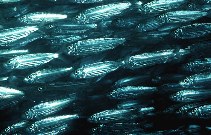
الأشواك الظهرية (المجموع) : 0; الأشعة الظهرية الناعمة (المجموع) : 16 - 23; شوكة شرجية: 0; أشعه شرجية لينه: 15 - 21. Diagnosis: Body slender, its depth 18 to 30% of standard length; presence of two fleshy outgrowths on the hind margin of the gill opening; sharp belly with keeled scutes, 16-19 pre-pelvic and 12-14 post-pelvic scutes (Ref. 188, 3259). The presence of elongate wing-like scales underneath the normal paired pre-dorsal scales separate it from all other species except the two Australian species with prominent black spots on the flank, Herklotsichthys koningsbergeri and Herklotsichthys Species A, and the unspotted Herklotsichthys Species B, which has dusky tips to dorsal and caudal fins and more lower gill rakers, 36-42 vs. 33-36 in H. quadrimaculatus (Ref. 188). Flank silvery with an electric blue line preceded by two orange spots (Ref. 188).
Body shape (shape guide): fusiform / normal; Cross section: oval.
Adults form schools near mangroves, shallow coastal bays and lagoons during the day and moves further offshore into deeper water by night (Ref. 188, 48635); at depths of 0-13m (Ref. 58302, 82332). Known in mills around in large schools under wharves or along sandy beaches in protected bays (Ref. 26367). Pelagic (Ref. 58302). Adults feed on zooplankton, mainly at night, chiefly copepods in juvenile stages, but larger prey as adults (chaetognaths, polychaetes, shrimps and small fishes) (Ref. 188). Breeding takes place during the first year and probably survives only a few months after maturity (Ref. 188). Migratory behaviour is undetermined (Ref. 126106). Marketed fresh and dried salted (Ref. 188). Usually parceled in leaves and baked in a motu oven. Do not recover quite as quickly as other species of baitfish after heavy fishing (Ref. 26367).
Oviparous (Ref. 205). Breeds during its first year and probably survives only a few months after maturity (Ref. 188).
Whitehead, P.J.P., 1985. FAO Species Catalogue. Vol. 7. Clupeoid fishes of the world (suborder Clupeoidei). An annotated and illustrated catalogue of the herrings, sardines, pilchards, sprats, shads, anchovies and wolf-herrings. FAO Fish. Synop. 125(7/1):1-303. Rome: FAO. (Ref. 188)
حالة القائمة الحمراء للاتحاد الدولي لحفظ الطبيعة والموارد الطبيعية (Ref. 130435: Version 2025-2 (Global))
خطر للأنسان
Potential pest (Ref. 6362)
استخدامات بشرية
مصائد: غير مهمة تجارياً; طعم: usually
أدوات
تقارير خاصة
تنزيل XML
مصادر علي الأنترنت
تقديرات تستند إلى النماذج
درجة الحرارة المفضلة (مرجع
123201): 24.9 - 29.3, mean 28.5 °C (based on 3173 cells).
مؤشر التنوع الشُعبي الوراثي (مرجع
82804): PD
50 = 0.5002 [Uniqueness, from 0.5 = low to 2.0 = high].
Bayesian length-weight: a=0.00933 (0.00571 - 0.01526), b=3.10 (2.96 - 3.24), in cm total length, based on LWR estimates for this species & (Sub)family-body (Ref.
93245).
مستوى غذائي (مرجع
69278): 3.6 ±0.4 se; based on diet studies.
Generation time: 1.1 ( na - na) years. Estimated as median ln(3)/K based on 1
growth studies.
المرونه (مرجع
120179): عالي, الحد الزمني الأدني لتضاعف عدد أفراد المجتمع أقل من 15 شهر (K=2.6).
ضعف الصيد (Ref.
59153): Low vulnerability (17 of 100).
🛈
قابلية التأثر بالمناخ (Ref.
125649): High vulnerability (58 of 100).
🛈
المغذيات (Ref.
124155): Calcium = 121 [63, 259] mg/100g; Iron = 1.42 [0.68, 2.55] mg/100g; Protein = 19.8 [18.5, 21.1] %; Omega3 = 0.215 [0.106, 0.453] g/100g; Selenium = 40.7 [18.6, 93.2] μg/100g; VitaminA = 42.4 [13.2, 139.7] μg/100g; Zinc = 1.82 [1.16, 2.83] mg/100g (wet weight);